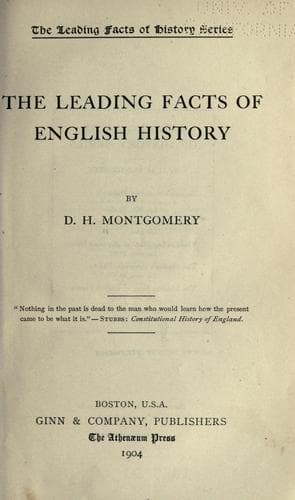
The Leading Facts of English HistoryMontgomery, D. H. (David Henry)
History
The Leading Facts of English History
Montgomery, D. H. (David Henry)
Great Britain -- History
Parliament, finding that this was bad both for the government and for
commerce, now abolished all of these duties except that on tea
(1770). That duty was retained for a double purpose: first, and
chiefly, to maintain the principle of the right of Great Britain to
tax the colonies; and, next, to aid the East India Company, which was
pleading piteeously for help.
In consequence mainly of the refusal of the American colonies to buy
tea, the London warehouses of the East India Company were full to
overflowing with surplus stock, and the company itself was in a
half-bankrupt condition. The custom had been for the company to bring
the tea to England, pay a tax on it, and then sell it to be reshipped
to America. To aid the company in its embarrassment, the Government
now agreed to remit this first duty altogether, and to impose a tax of
only threepence (six cents) a pound on the consumers in America.
In itself the threepenny tax was a trifle, as the ship-money tax of
twenty shillnigs was to John Hampden (S436); but underlying it was a
principle which seemed to the Americans, as it had seemed to Hampden,
no trifle; for such principles revolutions had been fought in the
past; for such they would be fought in the future.
The colonists resolved not to have the tea at any price. A number of
ships laden with the taxed herb arrived at the port of Boston. The
tea was seized by a band of men disguised as Indians, and thrown into
the harbor, 1773. The news of that action made the King and his
ministry furious. Parliament sympathized with the Government, and in
retaliation passed four laws of such severity that the colonists
nicknamed them the "Intolerable Acts."
The first law was the "Boston Port Act," which closed the harbor to
all trade; the second was the "Regulating Act," which virtually
annulled the charter of Massachusetts, took the government away from
the people, and gave it to the King; the third was the "Administration
of Justice Act," which ordered that Americans who committed murder in
resistance to oppression should be sent to England for trial; the
fourth was the "Quebec Act," which declared the country north of the
Ohio and east of the Mississippi a part of Canada.[1] The object of
this last act was to conciliate the French Canadians, and secure their
help against the colonists in case of rebellion.
[1] Embracing territory now divided into the five states of Ohio,
Indiana, Illinois, Michigan, and Wisconsin, with eastern Minnesota.
Public-domain text, read in full here on John Shaqi.
Reviews
Reviews
No reviews yet
Be the first to share your thoughts on this work.
Elsewhere in the archive
Join the Discussion
Join the discussion
Sign in to leave a comment or review.
Sign InorCreate an account