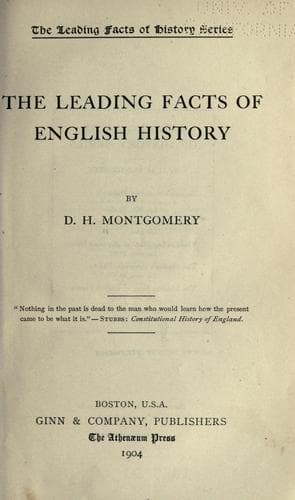
The Leading Facts of English HistoryMontgomery, D. H. (David Henry)
History
The Leading Facts of English History
Montgomery, D. H. (David Henry)
Great Britain -- History
Through the efforts of Sir Samuel Romilly, Jeremy Bentham, and others,
a reform was effected in this bloody code. Next, the labors of the
philanthropic John Howard, and later of Elizabeth Fry, purified the
jails of abuses which had made them not only dens of suffering and
disease, but schools of crime as well.
The laws respecting the pubishment for debt were also changed for the
better, and thousands of miserable beings who were without means to
satisfy their creditors were set free, instead of being kept in
useless lifelong imprisonment. At the same time Clarkson,
Wilberforce, Fox, and Pitt were endeavoring to abolish that relic of
barbarism, the African slave trade. After twenty years of persistent
effort both in Parliament and out, they at last accomplished that
great and beneficent work in 1807.
557. War with France (1793-1805); Battle of the Nile; Trafalgar, 1805.
Near the close of the century (1789) the French Revolution broke out.
It was a violent and successful attempt to destroy those feudal
institutions which France had outgrown, and which had, as we have
seen, disappeared gradually in England after the rebellion of Wat
Tyler (SS250, 252). At first the revolutionists received the hearty
sympathy of many of the Whig party (S479), but after the execution of
Louis XVI and Queen Marie Antoinette,[1] England became alarmed not
only at the horrible scenes of the Reign of Terror but at the
establishment of the French democratic republic which seemed to
justify them, and joined an alliance of the principal European powers
for the purpose of restoring monarchy in France.
[1] See "Death of Marie Antoinette," in Burke's "Reflections on the
French Revolution."
Napoleon had now become the real head of the French nation, and seemed
bent on making himself master of all Europe. He undertook an
expedition against Egypt and the East, which was intended as a
stepping-stone toward the ultimate conquest of the English empire in
India, but his plans were frustrated by Nelson, who completely
defeated the French fleet at the battle of the Nile (1798).
With the assistance of Spain, Napoleon next prepared to invade
England, and was so confident of success that he caused a gold medal
to be struck, bearing the inscription, "Descent upon England." "Struck
at London, 1804." But the English warships drove the French and
Spanish fleets into the harbor of Cadiz, and Napoleon had to postpone
his great expedition for another year.[2] In the autumn of 1805, the
French and Spanish fleets sallied forth determined to win. But Lord
Nelson, that frail little man who had lost his right arm and the sight
of his right eye fighting his country's battles, lay waiting for them
off Cape Trafalgar,[3] near by.
Public-domain text, read in full here on John Shaqi.
Reviews
Reviews
No reviews yet
Be the first to share your thoughts on this work.
Elsewhere in the archive
Join the Discussion
Join the discussion
Sign in to leave a comment or review.
Sign InorCreate an account