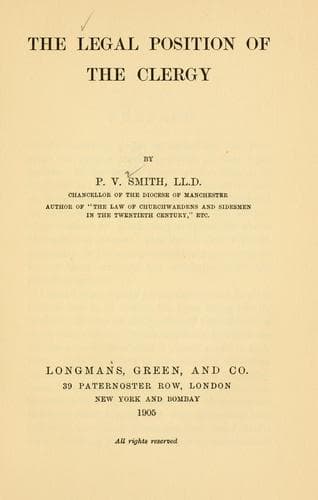
The Legal Position of the ClergySmith, Philip Vernon
Religion
The Legal Position of the Clergy
Smith, Philip Vernon
Canon law; Clergy -- Legal status, laws, etc. -- Great Britain; Ecclesiastical law -- Great Britain
of the benefice and other circumstances, and the bishop may direct that
the curate shall reside in the parsonage house.[120] (_d_) Where a
commission appointed to inquire into the matter has reported that the
ecclesiastical duties of a benefice are inadequately performed owing to
the negligence of the incumbent, the bishop may either require the
incumbent to nominate a curate or curates with sufficient stipend to be
licensed to perform or assist in performing the duties, or may himself
appoint a curate or curates to perform all or any of the duties, subject
to an appeal to the court constituted under the Benefices Act,
1898.[121] A minister in charge has the rights and powers of an
incumbent in certain particulars, such as the choice of a churchwarden,
and, if the benefice is vacant, but not if the incumbent is bankrupt,
the appointment of the parish clerk.[122] (_e_) Where under the New
Parishes Act, 1843, what is called a Peel district is constituted, and a
minister is licensed to it by the bishop, he occupies a somewhat
ambiguous position during the interval before it becomes a separate
ecclesiastical parish upon the consecration of a church within its
area. He is in many respects in the position of a perpetual curate,
being a corporation sole, subject to the jurisdiction of the bishop and
archdeacon, and independent of the incumbent of the parish so far as his
licence extends. But he has no power to take marriages or burials, and
the inhabitants of the district retain their ecclesiastical position as
parishioners of the parish out of which the district is formed.[123]
Public-domain text, read in full here on John Shaqi.
Reviews
Reviews
No reviews yet
Be the first to share your thoughts on this work.
Join the Discussion
Join the discussion
Sign in to leave a comment or review.
Sign InorCreate an account