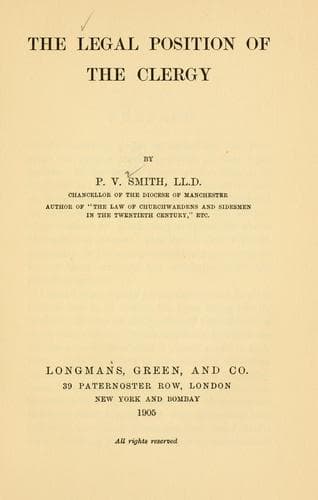
The Legal Position of the ClergySmith, Philip Vernon
Religion
The Legal Position of the Clergy
Smith, Philip Vernon
Canon law; Clergy -- Legal status, laws, etc. -- Great Britain; Ecclesiastical law -- Great Britain
3. Assistant unbeneficed clergy are contemplated by the canons, in which
they are styled curates; and with the licence of the bishop any
incumbent may employ one or more curates to assist him in serving the
parish. A curate frequently comes in the first instance on probation
without being licensed, and his tenure of office is then entirely
dependent on the will of the incumbent.[124] But after he is licensed it
becomes more secure; and, in the meantime, if a difficulty occurred
about the remuneration for his services, the law would give it to him
upon a _quantum meruit_. In order to obtain a licence, the curate must
present to the bishop a declaration by the incumbent undertaking to pay
to him a specified annual sum as his stipend and a declaration of his
own intention to receive the whole of that stipend; and the licence
will specify the amount of the stipend.[125] Any dispute between an
incumbent and a curate respecting the curate's stipend is to be decided
by the bishop, who may enforce payment of it by monition and
sequestration of the benefice.[126] If the benefice becomes vacant, a
curate must quit upon six weeks' notice from the new incumbent, if given
within six months from the date of admission to the benefice. But in
other cases, unless the bishop revokes his licence (see § 1 above), a
curate can only be required to quit after six months' notice given by
the incumbent with the previous written permission of the bishop, or of
the archbishop, if the bishop refuses it and the archbishop grants it
upon an appeal to him within one month after the bishop's refusal. On
the other hand, unless he obtains the express written consent of the
bishop, a curate before relinquishing a curacy to which he has been
licensed must give three months' notice of his intention to the
incumbent and the bishop, upon pain of forfeiting to the incumbent, as a
debt retainable out of his stipend or recoverable at law, such sum not
exceeding half a year's stipend as the bishop may in writing
direct.[127] Ordinarily, an incumbent who is himself resident and
performing the duties of his cure has complete discretion whether he
will employ any, and, if so, how many curates, and what duties shall
from time to time be performed by any whom he employs. But, besides the
cases of the incumbent's non-residence and negligence in the performance
of duties noticed above (§ 2 (_c_), (_d_)), the bishop has power, if a
commission issued by him reports that the duties of a benefice are
inadequately performed, to require the incumbent, although himself
engaged in performing them, to nominate an assistant curate or curates;
and, if he fails to do so within three months, the bishop may himself
appoint one or more, as the case may require, with a stipend
proportionate to the value of the benefice and the population of the
parish. The incumbent has an appeal to the archbishop, who may confirm
or amend the bishop's action.[128] Moreover, where the annual value of a
Public-domain text, read in full here on John Shaqi.
Reviews
Reviews
No reviews yet
Be the first to share your thoughts on this work.
Join the Discussion
Join the discussion
Sign in to leave a comment or review.
Sign InorCreate an account