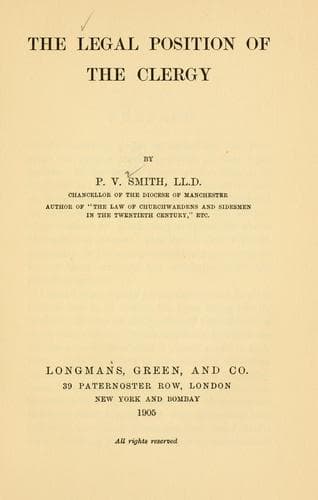
The Legal Position of the ClergySmith, Philip Vernon
Religion
The Legal Position of the Clergy
Smith, Philip Vernon
Canon law; Clergy -- Legal status, laws, etc. -- Great Britain; Ecclesiastical law -- Great Britain
benefice exceeds £500, and either the population amounts to 3000, or
there is a second church or chapel with a hamlet containing 400 persons,
the bishop may require the incumbent to nominate an assistant curate,
and, on his failing to do so within three months, may himself appoint
one with a stipend not exceeding £150; subject to a similar appeal to
the archbishop as in the case where the duties have been inadequately
performed.[129]
4. An incumbent has an absolute discretion as to permitting or refusing
any other clergyman, not being licensed as a curate to the parish, to
officiate within his parish, with this qualification, that he has no
right to permit any clergyman to officiate in his parish who by law is
debarred from taking duty in the diocese. With regard to this, no
unbeneficed clergyman has, strictly speaking, a right to officiate
publicly in a diocese, either in church or elsewhere, without the
licence or consent of the bishop, and his doing so is an ecclesiastical
offence.[130] But if the bishop has not actually inhibited him from
officiating, a clergyman may take merely temporary duty without
obtaining the formal licence of the bishop.[131] If, without being
either beneficed or licensed to a curacy in the diocese, he frequently
takes duty therein, he should obtain a general licence from the bishop
for the purpose. Canons 50 and 52 direct incumbents and churchwardens
not to suffer any one to preach in their churches without showing his
licence to preach, and require the names of strangers who preach with
the date of their preaching and the name of the bishop by whom they were
licensed, to be entered in a book for the information of the bishop of
the diocese.
5. In some parishes provision has been made for the election or
appointment of lecturers or preachers for the sole purpose of delivering
lectures or preaching sermons. In any such parish the bishop, if he
thinks fit, with the assent of the incumbent, may require the lecturer
or preacher to perform other ministerial duties as assistant curate or
otherwise, and may vary the duties from time to time. If the duties so
prescribed are not performed, the defaulter may be removed from his
office.[132]
Footnotes
[114] (1838) 1 & 2 Vict. c. 106, s. 82. For the stamp duty on licences,
and exemptions therefrom, see (1891) 54 & 55 Vict. c. 39, sch.
"Licence."
[115] 28 & 29 Vict. c. 122, ss. 1, 8; see ch. ii. § 6 (i.).
[116] Johns, vol. i. p. 95; see Ex parte Carlyon (1903) _Times_, Dec.
19; s.c. nom. R. _v._ Bp. of Liverpool (1904) _Times_, May 4.
[117] (1838) 1 & 2 Vict. c. 106, s. 98; Poole _v._ Bp. of London (1859)
5 Jur. N. S. 522; (1861) 14 Moo. P. C. 262; 7 Jur. N. S. 347.
[118] (1536) 28 Hen. 8, c. 11; (1838) 1 & 2 Vict. c. 106, ss. 99-101;
Dakins _v._ Seaman (1842) 9 M. & W. 777; (1885) 48 & 49 Vict. c. 54, s.
10.
[119] 34 & 35 Vict. c. 45 (Sequestration Act, 1871).
Public-domain text, read in full here on John Shaqi.
Reviews
Reviews
No reviews yet
Be the first to share your thoughts on this work.
Join the Discussion
Join the discussion
Sign in to leave a comment or review.
Sign InorCreate an account