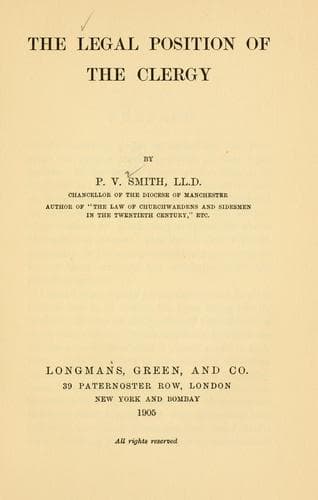
The Legal Position of the ClergySmith, Philip Vernon
Religion
The Legal Position of the Clergy
Smith, Philip Vernon
Canon law; Clergy -- Legal status, laws, etc. -- Great Britain; Ecclesiastical law -- Great Britain
vestry thereof. But the Vestries Act, 1818,[135] only applies to ancient
parishes. Consequently there is no plural voting in the quasi-vestry of
a new parish, nor need the notice summoning a vestry meeting be given on
a Sunday three clear days before the meeting.[136] But in other respects
a vestry or a meeting in the nature of a vestry in a new parish is
regulated by the same procedure as in an ancient parish. Since the
abolition of compulsory church rates in 1868, and the transfer of their
secular duties to other bodies, the functions of these vestries or
meetings, whether in old or in new parishes, have been for the most part
confined to the election of churchwardens and the approval, or the
contrary, of applications for faculties.[137] In some places under a
local Act or by the adoption of the Vestries Act, 1831,[138] the
functions of the vestry are exercised by a select vestry consisting of a
limited number of householders elected by the parishioners.
3. With regard to churchwardens, the general law as to their appointment
in ancient parishes is declared by the 89th and 90th Canons. They are to
be chosen, if possible, by the joint consent of the minister and
parishioners. But if these cannot agree upon the choice, the minister is
to choose one and the parishioners another. A stipendiary curate being
at the time in charge of the cure stands in the place of the incumbent
in the choice of churchwardens.[139] The election is to be annual, in
Easter week; but the same persons are re-eligible for any number of
years. By custom, however, there may be only one churchwarden or more
than two; and, as is the case in the City of London, both may by custom
be elected by the parishioners, or by the lord of the manor, or one by
the incumbent and the other by the outgoing churchwardens. The election
ordinarily takes place at the Easter vestry, but an election at another
time is valid.[140] The election of both churchwardens is the act of the
whole vestry, whether the minister and parishioners agree in their
choice, or the minister chooses one and the parishioners the other. In
the latter alternative, therefore, the vote of the minister is exhausted
in choosing his own warden, and he cannot also vote as a parishioner in
the election of the other warden; though if there is an equality of
votes in this election, he apparently can, as chairman of the vestry,
decide it by a casting vote.[141] In the case of all churches built
under the Church Building or New Parishes Acts, except those which have
no district attached to them, two churchwardens are to be annually
chosen at Eastertide, one by the minister and the other by the persons
entitled to attend and vote at a meeting in the nature of a vestry for
the parish or district attached to the church.[142] If the church has no
district attached to it, the choice of the second warden is vested in
the pewrenters, or, if there are no rented pews, the minister selects
Public-domain text, read in full here on John Shaqi.
Reviews
Reviews
No reviews yet
Be the first to share your thoughts on this work.
Join the Discussion
Join the discussion
Sign in to leave a comment or review.
Sign InorCreate an account