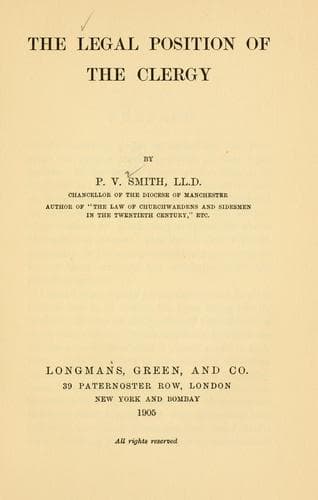
The Legal Position of the ClergySmith, Philip Vernon
Religion
The Legal Position of the Clergy
Smith, Philip Vernon
Canon law; Clergy -- Legal status, laws, etc. -- Great Britain; Ecclesiastical law -- Great Britain
both wardens.[143] Churchwardens, after their appointment, have no legal
right to exercise their office until they have been admitted by the
archdeacon at his visitation, or by the bishop or his chancellor during
the years of episcopal visitation, when the archdeacon is inhibited and
cannot act. Till then, their predecessors remain in office,
notwithstanding that their year has expired, and their successors have
been appointed.[144]
4. The two churchwardens are sometimes distinguished as the parson's or
vicar's warden and the people's warden. But there is no legal precedence
or seniority between the two, and though chosen differently their duties
are identical.[145] These may be enumerated as follows: (_a_) The care
of the fabric of the church, with its ornaments and furniture, and of
the churchyard; and the duty of keeping them in proper repair and
condition and of adequately insuring against fire so far as funds are in
hand for the purpose, except, as regards the chancel, where the rector
is liable for its repair.[146] They have no proprietary rights in the
church or its fixtures or in the churchyard, but the movable articles in
the church, including the bells and bell-ropes, and sums of money given
to the church, belong to them as a corporation for that purpose.[147]
(_b_) The seating of the parishioners and other churchgoers in the
church, including the chancel, subject, however, as regards the chancel
of an old parish church, to the right of the rector, whether spiritual
or lay, and his family, to the chief seat, and to his disposal of the
other chancel seats if the bishop or churchwardens take no action
respecting them. In this duty the churchwardens act as the officers of
the bishop, and are subject to his control if any complaint is made
against them. Neither the vestry nor the incumbent, nor any individual
parishioner, can interfere with their discretion in the matter, except
by appealing to the bishop. (_c_) The provision at the expense of the
parish of sacramental bread and wine and a surplice for the minister, as
required by Canons 20 and 58. (_d_) The maintenance of order in the
church and churchyard during Divine service. (_e_) The collection of the
money at the offertory, and concurrence with the minister in its
disposal to pious and charitable uses. (_f_) The charge of the church
and benefice and of providing for the cure of souls during a vacancy in
the living, if, as is usually the case, they are appointed
sequestrators, but not otherwise.[148] Churchwardens can neither add to,
alter, or remove any part of the church or its fittings without a
faculty, nor can they interfere with the clergyman in his ministrations
unless his conduct is such as to be riotous, violent, or indecent within
the meaning of the Act of 1860 against brawling.[149] The rights and
duties of the incumbent on the one hand, and of the churchwardens on the
other, in respect of the church and churchyard and the money and
Public-domain text, read in full here on John Shaqi.
Reviews
Reviews
No reviews yet
Be the first to share your thoughts on this work.
Join the Discussion
Join the discussion
Sign in to leave a comment or review.
Sign InorCreate an account