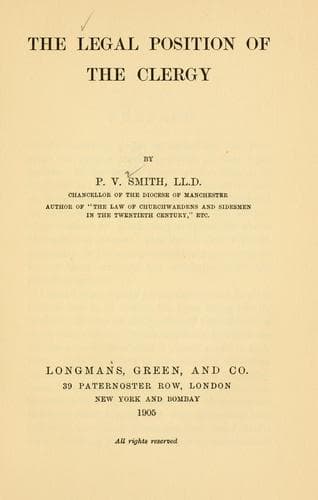
The Legal Position of the ClergySmith, Philip Vernon
Religion
The Legal Position of the Clergy
Smith, Philip Vernon
Canon law; Clergy -- Legal status, laws, etc. -- Great Britain; Ecclesiastical law -- Great Britain
9. Another old parochial office was that of beadle--the bidder, crier,
or messenger of the parish--whose duty was to attend in that capacity on
the incumbent, churchwardens, and vestry. His position and duties were
rather civil than ecclesiastical, but the vestry could sanction his
salary being paid out of the church rate. He was also frequently
employed to keep order in the church and churchyard during Divine
service; and the Church Building Act, 1831, enumerates the payment of
the salaries of beadles and pew-openers as well as of the clerk, as one
of the expenses incidental to the performance of Divine service, to be
paid out of the rents of pews in churches built under that Act.[157]
10. The organist and choristers, and any other lay officials beyond
those already mentioned, who may be employed in or about the church or
churchyard, are under the exclusive control and direction of the
incumbent, and, as a rule, are appointed by him. But in some parishes
the organist is, or was, when paid out of the church rate, selected by
the vestry. Whether he is appointed by them or by the incumbent, his
office is not a freehold; but he as well as the other officials now
under consideration may be dismissed from office on proper notice, the
length of which should be laid down at the time of appointment. If no
time is then fixed, the proper length of notice may, in case of dispute,
be a very difficult question to decide. It will depend in part on the
terms of the engagement, and of the salary. If the salary be so much per
month, probably one month's notice of dismissal would suffice. Not less
than three months' notice would be requisite if the salary is so much
per quarter; while if the salary is an annual sum, even this notice
might perhaps be insufficient. Whatever be the mode of appointment and
terms of the engagement of the organist, the incumbent has, within the
bounds of legality, and so far as he does not voluntarily surrender it,
the absolute right to control the use of the organ and the performance
of music in the church, both during Divine service and at other
times.[158] But, unless he is prepared to defray the cost out of his own
pocket, this right must, of course, in practice, be limited by the
extent to which the parishioners or congregation are willing to give the
necessary financial support to his arrangements.
Public-domain text, read in full here on John Shaqi.
Reviews
Reviews
No reviews yet
Be the first to share your thoughts on this work.
Elsewhere in the archive
Join the Discussion
Join the discussion
Sign in to leave a comment or review.
Sign InorCreate an account