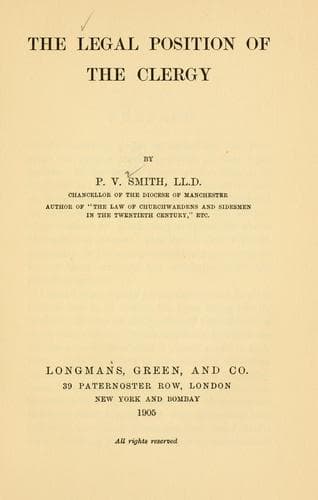
The Legal Position of the ClergySmith, Philip Vernon
Religion
The Legal Position of the Clergy
Smith, Philip Vernon
Canon law; Clergy -- Legal status, laws, etc. -- Great Britain; Ecclesiastical law -- Great Britain
7. The appointment and duties of the parish clerk vary in old and new
parishes, and depend in some cases on custom. In old parishes the office
is a freehold, and the right of appointment usually rests with the
incumbent, who can exercise it even when the living is sequestrated
owing to his bankruptcy; but in case of his being under suspension, it
devolves on the curate in charge. The right, however, may by custom
belong to the parishioners in vestry. An old writer compared the parish
clerk to a bat, as being half-bird, half-beast, or half-clerical and
half-lay, though he considered that his clerical wings outbalanced his
lay body. But it is now held that the office is temporal, and not
spiritual.[152] A person in holy orders may, however, with the consent
of the bishop, be appointed parish clerk under the Lecturers and Parish
Clerks Act, 1844, and, if so appointed, he is removable in the same way
as a stipendiary curate. The same Act provides for the suspension or
removal by the archdeacon, of a parish clerk not in holy orders, who has
been guilty of neglect or misbehaviour in his office, or of misconduct
which renders him unfit to hold it.[153] In all new ecclesiastical
parishes, on the other hand, the appointment of the clerk rests with the
incumbent, and, in the case of churches and chapels provided under the
Church Building Acts of 1818 and 1819, is made annually; while in the
case of those provided under the New Parishes Acts of 1843, 1844, and
1856, the clerk does not vacate his office at the end of each year, but
may at any time be removed by the incumbent, with the consent of the
bishop, for misconduct.[154]
8. There is no universal rule as to the appointment, duties, and tenures
of office of the sexton or sacristan. Where, in accordance with the
etymology of his name, his duties are confined to the custody of the
sacred vessels and vestments, the care and cleaning of the church, the
opening and closing of the doors, and the ringing of the bells, his
appointment, in the absence of a contrary practice, will naturally rest
with the churchwardens. Where, on the contrary, he has only to do with
the churchyard and grave-digging, his appointment will be presumed to be
in the hands of the incumbent. If, however, he is charged with both sets
of functions, the incumbent and the churchwardens jointly will be
presumed to have the right of appointing him. On the other hand, in some
few ancient parishes he is elected by the vestry. The office may be held
by a woman, and in some places is a freehold for life; but usually it is
held during pleasure, and the power of removal rests in the same hands
as that of the appointment.[155] In new ecclesiastical parishes the
sexton is to be appointed by the incumbent, and, with the consent of the
bishop, is removable by him for misconduct.[156]
Public-domain text, read in full here on John Shaqi.
Reviews
Reviews
No reviews yet
Be the first to share your thoughts on this work.
Elsewhere in the archive
Join the Discussion
Join the discussion
Sign in to leave a comment or review.
Sign InorCreate an account