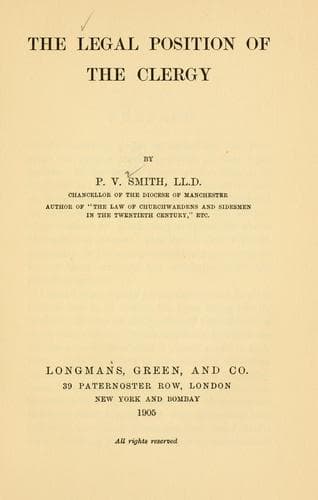
The Legal Position of the ClergySmith, Philip Vernon
Religion
The Legal Position of the Clergy
Smith, Philip Vernon
Canon law; Clergy -- Legal status, laws, etc. -- Great Britain; Ecclesiastical law -- Great Britain
[155] Ile's Case (1671) 1 Ventr. 153; R. _v._ Thame (Churchwardens)
(1719) 1 Str. 115; Olive _v._ Ingram (1739) 2 Str. 1114; R. _v._ Taunton
St. James (Churchwardens) (1776) 1 Cowp. 413; R. _v._ Minister, &c., of
Stoke Damerel (1836) 5 A. & E. 584, 590, sq.; Cansfield _v._ Blenkinsop
(1849) 4 Ex. 234.
[156] (1856) 19 & 20 Vict. c. 104, s. 9.
[157] 1 & 2 Will. 4, c. 38, s. 16.
[158] Wyndham _v._ Cole (1875) 1 P. D. 130.
[159] 3 Burn, 452; Strype's Annals, vol. i. ch. xiii., XXX. pp. 178-81,
345, sq.; (ed. 1824, pp. 265-69, 514-16); Martyn _v._ Hind (1776) 2
Cowp. 437, 438-39, 444.
[160] Particulars as to readers and their powers and functions in
consecrated buildings and elsewhere will be found in another Handbook of
the present Series: _Lay Work and the Office of Reader_, by Dr.
Yeatman-Biggs, afterwards made Bishop of Worcester.
[161] 2 Edw. 7, c. 42, s. 7 (6).
CHAPTER V
DIVINE SERVICE
1. Every deacon and priest before his ordination, and, as mentioned
above, every incumbent, before he is admitted to his benefice, and every
stipendiary curate, on entering upon his curacy, declares that in public
prayer and administration of the sacraments he will use the form
prescribed in the Book of Common Prayer and none other except so far as
ordered by lawful authority.[162] This uniform use is enjoined by the
Acts of Uniformity and the Prayer Book itself, which has legal force as
part of the Act of 1662, and by the 14th Canon, except so far as
modifications are permitted under the Act of Uniformity Amendment Act of
1872, which, like the Act of 1662, was passed at the instance of
Convocation.[163] No clergyman, therefore, may alter, add to, or
diminish the form of worship therein prescribed, including the
lessons.[164] The expression "lawful authority" occurs in the Act of
1662, which directs that in those portions of the Prayer Book which
relate to the King, Queen, or Royal progeny the names shall be altered
from time to time as occasion requires according to the direction of
lawful authority. This is explained by Bishop Gibson to mean, according
to practice, the authority of the Sovereign in Council.[165] The
archbishops and bishops have no authority, combined or singly, to order
modifications of or additions to the forms of Divine service, except to
the extent permitted by the Act of 1872. The Preface to the Prayer Book
"Concerning the Service of the Church" expressly contemplates that in
lieu of diversity of use in different dioceses and parts of the realm,
all shall henceforth have but one use. The only function of the prelates
which it recognises in the matter is the power of the bishop to set at
rest any doubts which may arise as to the construction of the Prayer
Book and the proper practice thereunder, with liberty to him, if he is
himself in doubt, to refer to the archbishop. But the Act of 1872
permits (_a_) the use, upon a special occasion approved by the ordinary,
Public-domain text, read in full here on John Shaqi.
Reviews
Reviews
No reviews yet
Be the first to share your thoughts on this work.
Elsewhere in the archive
Join the Discussion
Join the discussion
Sign in to leave a comment or review.
Sign InorCreate an account