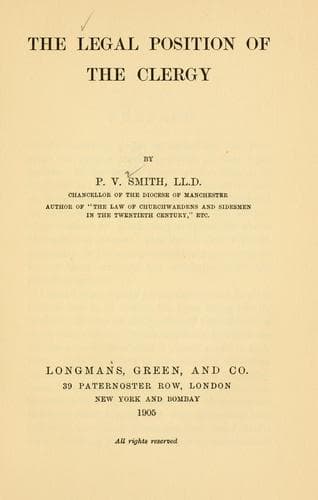
The Legal Position of the ClergySmith, Philip Vernon
Religion
The Legal Position of the Clergy
Smith, Philip Vernon
Canon law; Clergy -- Legal status, laws, etc. -- Great Britain; Ecclesiastical law -- Great Britain
of a special form of service approved by him, and containing nothing
except anthems or hymns, which does not form part of the Holy Scriptures
or Book of Common Prayer, and also (_b_) the use, on any Sunday or holy
day, as supplementary to the services prescribed by the Prayer Book, of
an additional form of service, approved by the ordinary as to its form
and mode of use, and containing no portion of the Communion Service and
nothing except anthems or hymns which does not form part of the Holy
Scriptures or Book of Common Prayer. The same Act authorises the use of
a shortened order for Morning or Evening Prayer on any day except
Sunday, Christmas Day, Ash Wednesday, Good Friday, and Ascension Day;
and the use of the Morning Prayer, the Litany, and the Communion
Service, in varying order as separate services,[166] and the saying of
the Litany after the third collect in Evening Prayer, without prejudice
to any legal powers vested in the ordinary, and either with or without a
sermon, lecture, or homily; and also the preaching of a sermon without
being preceded by a service appointed by the Prayer Book, provided that
it be preceded by a service authorised by the Act, or by a collect from
the Prayer Book with or without the Lord's Prayer.
2. The Prayer Book contains an "Order for Morning and Evening Prayer
daily to be said and used throughout the year"; and under the prefatory
heading "Concerning the Service of the Church," it is directed that all
priests and deacons are to say daily the Morning and Evening Prayer
either privately or openly, not being let by sickness or some other
urgent cause. And the curate who ministers in a parish church, being at
home and not being otherwise reasonably hindered, is to say the same in
the church, after summoning the people by a bell to come and hear God's
word and pray with him. A bishop, however, has no power to enforce daily
services;[167] and daily service has been held not to be requisite under
a trust to perform the service "in strict and literal accordance with
the order of the Book of Common Prayer."[168] But the Act of Uniformity
of 1662, s. 1, expressly enacts that the morning and evening prayers
contained in that Book shall, on every Lord's Day, and on all other days
and occasions, and at the times therein appointed, be openly read by
every minister or curate in every church, chapel, or other place of
public worship.[169] And the 14th and 15th Canons direct that the Common
Prayer shall be said or sung distinctly and reverently upon such days as
are appointed to be kept holy by the Prayer Book and their eves, and
that the Litany shall be said or sung when and as prescribed in the
Prayer Book; and in particular on Wednesdays and Fridays weekly, though
they be not holy days, the minister at the accustomed hours of service
is to resort to the church and say the Litany after warning the people
by tolling a bell. A later enactment empowers the bishop, at his
Public-domain text, read in full here on John Shaqi.
Reviews
Reviews
No reviews yet
Be the first to share your thoughts on this work.
Elsewhere in the archive
Join the Discussion
Join the discussion
Sign in to leave a comment or review.
Sign InorCreate an account