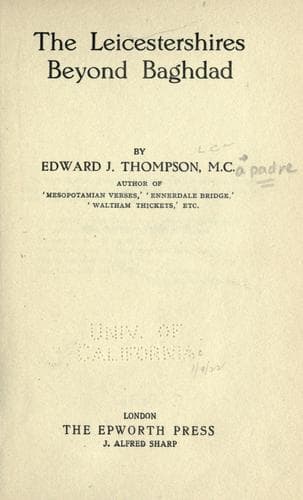
The Leicestershires beyond BaghdadThompson, Edward John
History
The Leicestershires beyond Baghdad
Thompson, Edward John
World War, 1914-1918 -- Campaigns -- Iraq
Public opinion had condemned
his coming, for the soldier holds that no man should go under fire
unless he has a definite job there. But when he justified his place by
a score of deeds, from cigarette-distributing to bandaging the wounded,
public opinion rejoiced and accepted him, known for a comrade and a
brave man.
Along the plain the enemy had a number of large thorn-stacks, with
sand-bagged seats in their centres. Here had been snipers. These stacks
we avoided; as we did, as a rule, all such things as battalion head
quarters. The colonel of a regiment moves with a small army of
orderlies; his majestic appearance over a brow rarely fails to draw a
few salvoes. The doctor's meinie, therefore, took their way along the
open, avoiding all prominences of landscape and people. I turned aside
to what proved to be a 56th Rifles' aid-post, with a dead horse before
it. Here had been the first Turkish lines. Our guns pushed on very
rapidly, the gunners riding swiftly by and into a large, deep nulla. We
overpassed them again; there was one smart minute or so when half a
dozen 'pipsqueaks' burst in a narrow fault of the ground, scarcely a
nulla, beside us, the steep sides killing the spread of the H.E. The
enemy had been shrapnelling hard along the line occupied by the 56th
Rifles and the Leicestershires. Nevertheless we picked up very few
wounded.
Johnny's shrapnel now began to get wilder still. We found Colonel
Brock, the Leicestershires' colonel, where several wide, big nullas
met. The battalion was digging in, he said. About thirty prisoners came
over a hill behind us. We set up an aid-post, our first stationary one;
Sarcka produced a tin of Maconochie, and we had tiffin. A few wounded
Indians came, the first being a man from whose pocket-book we extracted
a shrapnel bullet. He had no other hurt.
The colonel was puzzled at our few casualties. There had been not only
a good deal of shrapnel, but heavy rifle and machine-gun fire, yet
hardly a man had been hit. The fight was nearly over, so I went back
for ambulances. John was throwing a certain amount of explosive stuff
about, uselessly and recklessly. On my way back I found Owen, of the
51st Sikhs, with a wounded arm. Owen, long ago, lost an eye in a
bombing accident at Sannaiyat. He pluckily returned from India, and
again took over the work of bombing instructor to his regiment.
It was now getting hot, being well past nine o'clock.
Public-domain text, read in full here on John Shaqi.
Reviews
Reviews
No reviews yet
Be the first to share your thoughts on this work.
Elsewhere in the archive
Join the Discussion
Join the discussion
Sign in to leave a comment or review.
Sign InorCreate an account