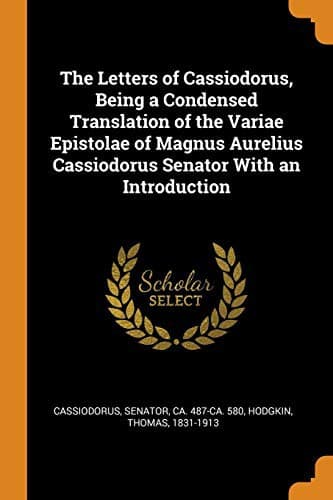
The Letters of Cassiodorus: Being a Condensed Translation of the Variae Epistolae of Magnus Aurelius Cassiodorus SenatorCassiodorus, Senator
History
The Letters of Cassiodorus: Being a Condensed Translation of the Variae Epistolae of Magnus Aurelius Cassiodorus Senator
Cassiodorus, Senator
Goths -- Italy; Italy -- History -- 476-1268
(7) The _Subadjuvae_. This is probably a somewhat vague term, like
Adjutores, and indicates a second and lower class of cashiers who
acted as deputies for the regular Numerarii.
[Sidenote: Cura Epistolarum.]
(8) _Cura Epistolarum._ The officer who bore this title appears to
have had the duty of copying out all letters relating to fiscal
matters[163]. This theory as to his office is confirmed by the words
of Cassiodorus (Var. xi. 23): 'Let Constantinian on his promotion
receive the care of the letters relating to the land-tax' (Hic itaque
epistolarum _canonicarum_ curam provectus accipiat).
[Footnote 163: This is Bethmann Hollweg's interpretation of the words
of Lydus, [Greek: hoi tas men epi tois demosiois phoitosas psephous
graphousi monon, to loipon kataphronoumenoi] (iii. 21). In another
passage (iii. 4, 5) Lydus appears to assign a reason for the fact that
the Praefectus Urbis Constantinopolitanae, the Magister Militum, and
the Magister Officiorum had no _Cura Epistolarum_ on their staff; but
the paragraph is to me hopelessly obscure. Curiously enough, too,
while he avers that every department of the State (perhaps every
diocese) had, as a rule, its own Curae Epistolarum, he limits the two
in the Praetorian Praefect's office to the diocese of Pontica ([Greek:
koura epistolaroum Pontikes duo]).]
[Sidenote: Regerendarius, or Regendarius.]
(9) _Regerendarius_, or _Regendarius_[164]. This officer had the
charge of all contracts relating to the very important department of
the _Cursus Publicus_, or Imperial Mail Service. At the time of the
compilation of the 'Notitia' only one person appears to have acted in
this capacity under each Praefect. When Lydus wrote, there were two
Regendarii in each Praefecture, but, owing to the increasing influence
of the Magister Officiorum over the Cursus Publicus[165], their office
had become apparently little more than an ill-paid sinecure. As we
hear nothing of similar changes in the West, the Cursus Publicus was
probably a part of the public service which was directly under the
control of Cassiodorus when Praetorian Praefect, and was administered
at his bidding by one or more Regendarii.
[Footnote 164: The first form of the name is found in the Notitia, the
second in Lydus and Cassiodorus.]
[Footnote 165: It is not easy to make out exactly what Lydus wishes us
to understand about the Cursus Publicus; but I think his statements
amount to this, that it was taken by Arcadius from the Praetorian
Praefect and given to the Magister Officiorum, was afterwards restored
to the Praefect, and finally was in effect destroyed by the corrupt
administration of John of Cappadocia. (See ii. 10; iii. 21, 61.)]
[Sidenote: Exceptores.]
(10) We now come to the _Exceptores_, or shorthand writers[166], a
large and fluctuating body who stood on the lowest step of the
official ladder[167] and formed the raw material out of which all its
higher functionaries were fashioned in the regular order of promotion.
Public-domain text, read in full here on John Shaqi.
Reviews
Reviews
No reviews yet
Be the first to share your thoughts on this work.
Elsewhere in the archive
Join the Discussion
Join the discussion
Sign in to leave a comment or review.
Sign InorCreate an account