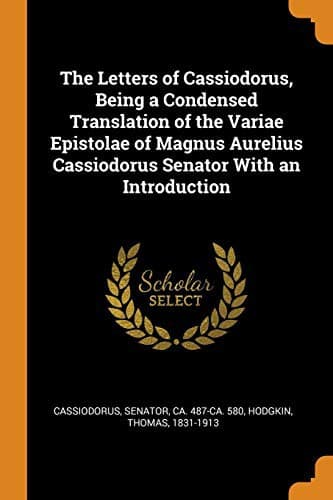
The Letters of Cassiodorus: Being a Condensed Translation of the Variae Epistolae of Magnus Aurelius Cassiodorus SenatorCassiodorus, Senator
History
The Letters of Cassiodorus: Being a Condensed Translation of the Variae Epistolae of Magnus Aurelius Cassiodorus Senator
Cassiodorus, Senator
Goths -- Italy; Italy -- History -- 476-1268
'Now the Scriniarii [subordinates of the Magister Officiorum] are made
Cancellarii and Logothetes and purveyors of the Imperial table,
whereas in old time the Cancellarius was chosen only from the ranks of
Augustales and Exceptores who had served with credit. In those days
the Judgment Hall [of the Praefect] recognised only two Cancellarii,
who received an _aureus_ apiece[176] per day from the Treasury. There
was aforetime in the Court of Justice a fence separating the
Magistrate from his subordinates, and this fence, being made of long
splinters of wood placed diagonally, was called _cancellus_, from its
likeness to network, the regular Latin word for a net being casses,
and the diminutive cancellus[177]. At this latticed barrier then stood
two _Cancellarii_, by whom, since no one was allowed to approach the
judgment-seat, paper was brought to the members of the staff and
needful messages were delivered. But now that the office owing to the
number of its holders[178] has fallen into disrepute, and that the
Treasury no longer makes a special provision for their maintenance,
almost all the hangers-on of the Courts of Law call themselves
Cancellarii; and, not only in the capital but in the Provinces, they
give themselves this title in order that they may be able more
effectually to plunder the wealthy.'
[Footnote 176: About twelve shillings.]
[Footnote 177: This derivation from casses is, of course, absurd.]
[Footnote 178: Can this be the meaning of [Greek: eis plethos]?]
This description by Lydus, while it aptly illustrates Cassiodorus'
exhortations to his Cancellarii to keep their hands clean from bribes,
shows how lowly their office was still considered; and indeed, but for
his statement that it used to be filled by veteran Augustales, we
might almost have doubted whether it is rightly classed among the
'Learned Services' at all.
[Sidenote: End of the Militia Literata.]
Now at any rate we leave the ranks of the gentlemen of the Civil
Service behind us, and come to the 'Militia Illiterata,' of whom the
'Notitia' enumerates only
[Sidenote: Militia Illiterata: Singularii.]
(13) The _Singularii_, a class of men of whose useful services Lydus
speaks in terms of high praise, contrasting their modest efficiency
with the pompous verbosity[179] of the Magistriani (servants of the
Master of the Offices) by whom they were being generally superseded in
his day. They travelled through the Provinces, carrying the Praefect's
orders, and riding in a post-chaise drawn by a single horse (veredus),
from which circumstance, according to Lydus, they derived their name
Singularii[180].
[Footnote 179: [Greek: Kompophakellorremosyne] =
Pomp-bundle-wordiness, an Aristophanic word.]
[Footnote 180: De Dignitatibus iii. 7.]
Public-domain text, read in full here on John Shaqi.
Reviews
Reviews
No reviews yet
Be the first to share your thoughts on this work.
Elsewhere in the archive
Join the Discussion
Join the discussion
Sign in to leave a comment or review.
Sign InorCreate an account