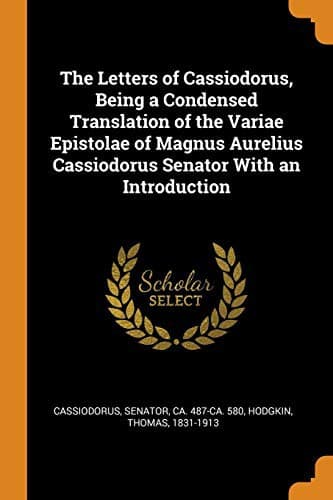
The Letters of Cassiodorus: Being a Condensed Translation of the Variae Epistolae of Magnus Aurelius Cassiodorus SenatorCassiodorus, Senator
History
The Letters of Cassiodorus: Being a Condensed Translation of the Variae Epistolae of Magnus Aurelius Cassiodorus Senator
Cassiodorus, Senator
Goths -- Italy; Italy -- History -- 476-1268
'We must add, moreover, that when you were on frequent occasions
charged with the office of the Quaestorship, the leisure which you
might have enjoyed was taken from you by your own constant
thoughtfulness for the public good; and when you were thus bearing the
weight of an honour which was not the highest, your Sovereigns used to
lay upon you those duties, properly belonging to other offices, which
their own holders were unable to discharge[196]. All these duties you
discharged with absolute freedom from corruption, following your
father's example in receiving, from those who hoped for your favour,
nothing but the obligation to serve them, and bestowing on petitioners
all that they had a right to ask for without traffic or reward.
[Footnote 196: 'Addimus etiam quod frequenter Quaesturae vicibus
ingravato otii tempus adimit crebra cogitatio, et velut mediocribus
fascibus insudanti, illa tibi de aliis honoribus principes videntur
imponere, quae proprii Judices nequeunt explicare.' This is probably
the clearest account that is anywhere given of the peculiar and
somewhat undefined position held by Cassiodorus during the greater
part of the reign of Theodoric.]
[Sidenote: Intimacy with Theodoric.]
'Moreover, men know that the conversations which you were honoured by
holding with the King occupied a large portion of your days, greatly
to the public welfare[197], so that men of leisure have no right to
expect that their requirements shall be met by you, whose day was thus
occupied with continuous toil[198]. But in truth this will redound yet
more to your glory, if amid so many and such severe labours you
succeed in writing that which is worthy to be read. Besides, your work
can without wounding their self-love instruct unlettered persons who
are not prepared by any consciousness of eloquence for the service of
the Republic[199]; and the experience which you have gained by being
tossed to and fro on the waves of stormy altercation, they in their
more tranquil lot may more fortunately make their own. Again (and here
we make an appeal which your loyalty cannot resist), if you allow
posterity to be ignorant of the numerous benefits conferred by your
King, it is in vain that with benevolent eagerness he so often granted
your requests. Do not, we pray, draw back once more into silence and
obscurity those who, while you were sounding their eulogies, seemed
worthy to receive illustrious dignities. For you then professed to
describe them with true praises, and to paint their characters with
the colours of history[200]. Now if you leave it to posterity to write
the panegyric on these men, you take away as it were from those who
die an honourable death the funeral oration to which, by the customs
of our ancestors, they are entitled. Besides, in these letters you
correct immorality with a ruler's authority; you break the insolence
of the transgressor; you restore to the laws their reverence. Do you
Public-domain text, read in full here on John Shaqi.
Reviews
Reviews
No reviews yet
Be the first to share your thoughts on this work.
Elsewhere in the archive
Join the Discussion
Join the discussion
Sign in to leave a comment or review.
Sign InorCreate an account