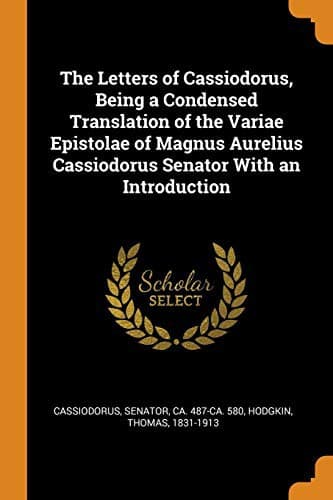
The Letters of Cassiodorus: Being a Condensed Translation of the Variae Epistolae of Magnus Aurelius Cassiodorus SenatorCassiodorus, Senator
History
The Letters of Cassiodorus: Being a Condensed Translation of the Variae Epistolae of Magnus Aurelius Cassiodorus Senator
Cassiodorus, Senator
Goths -- Italy; Italy -- History -- 476-1268
As the letter is addressed to a learned man, it seems a suitable
opportunity to explain why Antiquity reared this mighty pile.
Accordingly a very long digression follows on the origin, progress,
and decline of Tragedy, Comedy, and Pantomime.
It is remarked incidentally that Pompeius seems to have derived his
appellation _Magnus_ chiefly from the building of this wonderful
theatre.
The expense which Symmachus has been put to in these vast works is to
be refunded to him by the _Praepositus Sacri Cubiculi_, that he may
still have the glory of the work, but that the King may have done his
due part in preserving the memorials of Antiquity.
BOOK V.
CONTAINING FORTY-FOUR LETTERS WRITTEN BY CASSIODORUS IN THE NAME OF
THEODORIC.
1. KING THEODORIC TO THE KING OF THE VANDALS[370].
[Footnote 370: No doubt Thrasamund, who married Theodoric's sister. He
reigned from 496 to 523.]
[Sidenote: The King of the Vandals is thanked for his presents.]
'The swords which you have sent us are most beautiful: so sharp that
they will cut other weapons; so bright that they reflect with a sort
of iron light[371] the face of the beholder; with the two blades
descending to their edges with such absolute equality of slope, that
you would fancy them the result of the furnace rather than of the
whetstone[372]; in the middle, between the blades, channels carved
which are filled in with beautiful enamel of various colours[373].
[Footnote 371: 'Ut speculum quoddam virorum faciat ferream lucem.']
[Footnote 372: 'Quarum margines in acutum tali aequalitate descendunt,
ut non limis compositae, sed igneis fornacibus credantur effusae.']
[Footnote 373: 'Harum media pulchris alveis excavata, quibusdam
videntur crispari posse vermiculis, ubi tanta varietatis umbra
concludit, ut intextum magis credas variis coloribus lucidum
metallum.']
'Along with these arms you have also sent us musical instruments of
ebony, and slave boys of beautiful whiteness.
'We thank you heartily, send by A and B, our ambassadors, presents of
equal value; and hope that mutual concord will always unite our
States.'
2. KING THEODORIC TO THE HAESTI.
[Sidenote: The Haesti, dwellers by the Baltic. Their present of
amber.]
[These are the Aestii of Tacitus, dwelling in or on the south border
of the country which is still called Esthonia. Tacitus also mentions
their quest of amber[374].]
[Footnote 374: Germ. 45: 'Ergo jam dextro Suevici maris litore
Aestiorum gentes alluuntur, quibus ritus habitusque Suevorum, lingua
Britannicae propior.... Sed et mare scrutantur ac soli omnium sucinum
quod ipsi glesum vocant, inter vada atque in ipso littore legunt.'
Then follows an account of the nature of amber, and a history of its
supposed origin, from which Cassiodorus has borrowed in this letter.]
'It is gratifying to us to know that you have heard of our fame, and
have sent ambassadors who have pressed through so many strange nations
to seek our friendship.
Public-domain text, read in full here on John Shaqi.
Reviews
Reviews
No reviews yet
Be the first to share your thoughts on this work.
Elsewhere in the archive
Join the Discussion
Join the discussion
Sign in to leave a comment or review.
Sign InorCreate an account