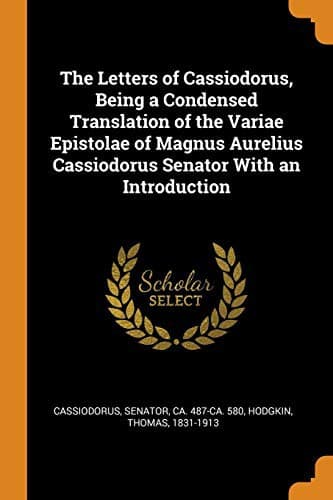
The Letters of Cassiodorus: Being a Condensed Translation of the Variae Epistolae of Magnus Aurelius Cassiodorus SenatorCassiodorus, Senator
History
The Letters of Cassiodorus: Being a Condensed Translation of the Variae Epistolae of Magnus Aurelius Cassiodorus Senator
Cassiodorus, Senator
Goths -- Italy; Italy -- History -- 476-1268
Lydus continues[134]: 'Now, what followed, like the Peleus of
Euripides, I can never describe without tears. For on account of all
these sources of revenue having been dried up, I myself have had to
bear my part in the general misery of our time, since, though I have
reached the highest grade of promotion in the service, I have derived
nothing from it but the bare name. I do not blush to call Justice
herself as a witness to the truth of what I say, when I affirm that I
am not conscious of having received one obol from the Princeps, nor
from the Letters Patent for promotions in the office[135]. For indeed
whence should I have derived it, since it was the ancient custom that
those who in any way appeared in the highest courts should pay to the
_officium_ seven and thirty _aurei_ [L22] for a "one-membered" suit;
but ever after this bargain was made there has been given only a very
moderate sum of copper--not gold--in a beggarly way, as if one were
buying a flask of oil, and that not regularly? Or how compel the
Princeps to pay the ancient covenanted sum to the Cornicularius of the
day, when he now scarcely remembered the bare name of that officer, as
he never condescended to be present in the court when promotions were
made from a lower grade to a higher? Bitterly do I regret that I was
so late in coming to perceive for what a paltry price I was rendering
my long services as assistant in the courts, receiving in fact nothing
therefrom as my own _solatium_. It serves me right, however, for
having chosen that line of employment, as I will explain, if the
reader will allow me to recount to him my career from its commencement
to the present time.'
[Footnote 134: De Mag. iii. 25.]
[Footnote 135: [Greek: apo ton legomenon kompleusimon], apparently the
same source of revenue as the promotion-money ([Greek: ten ek tou
bathmou pronomian]).]
Lydus then goes on to describe his arrival at Constantinople (A.D.
511), his intention to enter the _Scrinium Memoriae_ (in which he
would have served under the Magister Officiorum), and his abandonment
of this intention upon the pressing entreaties of his countryman
Zoticus, who was at the time Praefectus Praetorio. This step Lydus
looks upon as the fatal mistake of his life, though the consequences
of it to him were in some degree mitigated by the marriage which
Zoticus enabled him to make with a lady possessed of a fortune of 100
pounds' weight of gold (L4,000). Her property, her virtues (for 'she
was superior to all women who have ever been admired for their moral
excellence'), and the consolations of Philosophy and Literature, did
much to soothe the disappointment of Lydus, who nevertheless felt,
when he retired to his books after forty years of service, in which he
had reached the unrewarded post of Cornicularius, that his official
life had been a failure.
Public-domain text, read in full here on John Shaqi.
Reviews
Reviews
No reviews yet
Be the first to share your thoughts on this work.
Elsewhere in the archive
Join the Discussion
Join the discussion
Sign in to leave a comment or review.
Sign InorCreate an account