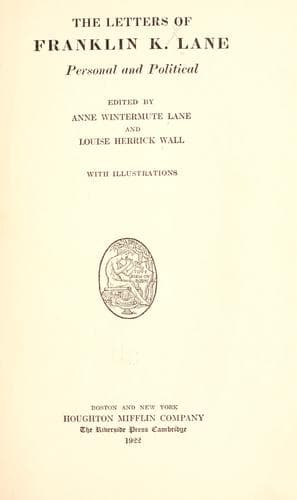
The Letters of Franklin K. Lane, Personal and PoliticalLane, Franklin K.
History
The Letters of Franklin K. Lane, Personal and Political
Lane, Franklin K.
United States -- Politics and government -- 1913-1921; World War, 1914-1918 -- United States
DEAR MR. BROUGHAM,-- ... I recently returned from the Yankton
Sioux Reservation in South Dakota where I admitted some one
hundred and fifty competent Indians to full American citizenship
in accordance with a ritual. ... The ceremony was really
impressive and taken quite seriously by the Indians. Why should
not some such ceremony as this be used when we give citizenship to
foreigners who come to this country? Surely it tends to instil
patriotism and presents the duties of citizenship in a manner that
leaves a lasting impression. Here is a story that should be
interesting to all, if properly presented. Cordially yours,
FRANKLIN K. LANE
INDIAN RITUAL ADMISSION TO CITIZENSHIP
The Secretary stands before one of the candidates and says:--
"Joseph T. Cook, what was your Indian name?"
"Tunkansapa," answers the Indian.
"Tunkansapa, I hand you a bow and arrow. Take this bow and shoot
the arrow."
The Indian does so.
"Tunkansapa, you have shot your last arrow. That means you are no
longer to live the life of an Indian. You are from this day
forward to live the life of the white man. But you may keep that
arrow. It will be to you a symbol of your noble race and of the
pride you may feel that you come from the first of all Americans."
Addressing Tunkansapa by his white name.
"Joseph T. Cook, take in your hands this plough." Cook does so.
"This act means that you have chosen to live the life of the white
man. The white man lives by work. From the earth we must all get
our living, and the earth will not yield unless man pours upon it
the sweat of his brow.
"Joseph T. Cook, I give you a purse. It will always say to you
that the money you gain must be wisely kept. The wise man saves
his money, so that when the sun does not smile and the grass does
not grow he will not starve."
The Secretary now takes up the American flag. He and the Indian
hold it together.
"I give into your hands the flag of your country. This is the only
flag you ever will have. It is the flag of free men, the flag of a
hundred million free men and women, of whom you are now one. That
flag has a request to make of you, Joseph T. Cook, that you repeat
these words."
Cook then repeats the following after the Secretary.
"Forasmuch as the President has said that I am worthy to be a
citizen of the United States, I now promise this flag that I will
give my hands, my head, and my heart to the doing of all that will
make me a true American citizen."
The Secretary then takes a badge upon which is the American eagle,
with the national colors, and, pinning it upon the Indian's
breast, speaks as follows:--
"And now, beneath this flag, I place upon your breast the emblem
of citizenship. Wear this badge always, and may the eagle that is
on it never see you do aught of which the flag will not be proud."
TO FREDERIC J. LANE
Washington, June 6, 1916
Public-domain text, read in full here on John Shaqi.
Reviews
Reviews
No reviews yet
Be the first to share your thoughts on this work.
Elsewhere in the archive
Join the Discussion
Join the discussion
Sign in to leave a comment or review.
Sign InorCreate an account