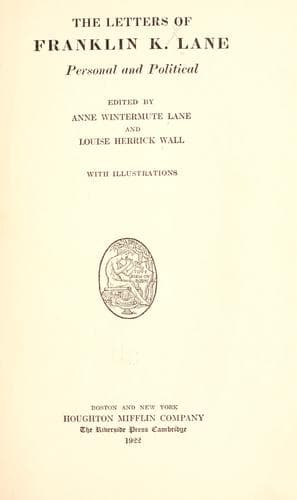
The Letters of Franklin K. Lane, Personal and PoliticalLane, Franklin K.
History
The Letters of Franklin K. Lane, Personal and Political
Lane, Franklin K.
United States -- Politics and government -- 1913-1921; World War, 1914-1918 -- United States
MY DEAR GEORGE,--I am going to write you in confidence some of the
talks we have at the Cabinet and you may keep these letters in
case I ever wish to remind myself of what transpired. A week ago
yesterday, (February 1st), the word came that Germany was to turn
"mad dog" again, and sink all ships going within her war zone.
This was the question, of course, taken up at the meeting of the
Cabinet on February 2nd. The President opened by saying that this
notice was an "astounding surprise." He had received no intimation
of such a reversal of policy. Indeed, Zimmermann, the German
Minister of Foreign Affairs, had within ten days told Gerard that
such a thing was an "impossibility." At this point Lansing said
that he had good reason to believe that Bernstorff had the note
for fully ten days before delivering it, and had held it off
because of the President's Peace Message to Congress, which had
made it seem inadvisable to deliver it then. In answer to a
question as to which side he wished to see win, the President said
that he didn't wish to see either side win,--for both had been
equally indifferent to the rights of neutrals--though Germany had
been brutal in taking life, and England only in taking property.
He would like to see the neutrals unite. I ventured the expression
that to ask them to do this would be idle, as they could not
afford to join with us if it meant the insistence on their rights
to the point of war. He thought we might coordinate the neutral
forces, but was persuaded that an effort to do this publicly, as
he proposed, would put some of the small powers in a delicate
position. We talked the world situation over. I spoke of the
likelihood of a German-Russian-Japanese alliance as the natural
thing at the end of the war because they all were nearly in the
same stage of development. He thought the Russian peasant might
save the world this misfortune. The fact that Russia had been, but
a short time since, on the verge of an independent peace with
Germany was brought out as evidencing the possibility of a break
on the Allies' side. His conclusion was that nothing should be
done now,--awaiting the "overt act" by Germany, which would take
him to Congress to ask for power.
At the next meeting of the Cabinet on February 6th, the main
question discussed was whether we should convoy, or arm, our
merchant ships. Secretary Baker said that unless we did our ships
would stay in American ports, and thus Germany would have us
effectively locked up by her threat. The St. Louis, of the
American line, wanted to go out with mail but asked the right to
arm and the use of guns and gunners. After a long discussion, the
decision of the President was that we should not convoy because
that made a double hazard,--this being the report of the Navy,--
but that ships should be told that they MIGHT arm, but that
without new power from Congress they should not be furnished with
guns and gunners.
Public-domain text, read in full here on John Shaqi.
Reviews
Reviews
No reviews yet
Be the first to share your thoughts on this work.
Elsewhere in the archive
Join the Discussion
Join the discussion
Sign in to leave a comment or review.
Sign InorCreate an account