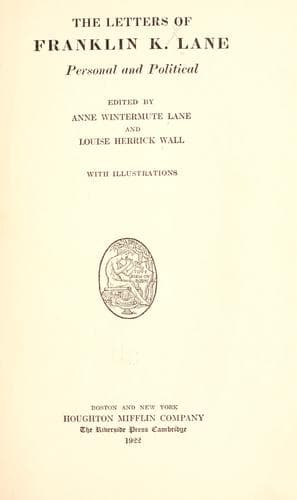
The Letters of Franklin K. Lane, Personal and PoliticalLane, Franklin K.
History
The Letters of Franklin K. Lane, Personal and Political
Lane, Franklin K.
United States -- Politics and government -- 1913-1921; World War, 1914-1918 -- United States
The greatest impending danger is the drive on the east front into
Russia, possibly the taking of Petrograd, and the weakness on the
part of the Russians because of so large a socialistic element now
in control of Russian affairs. We offered Russia a commission of
railroad men to look over their railroad systems and advise with
them as to the best means of operating them. At first Russia
inclined to welcome such a commission, but later the offer was
declined because of local feeling. We intend to send a commission
ourselves to Russia, possibly headed by McAdoo or Root, and on
this commission we will have a railroad man with expert knowledge
who can be of some service to them, I hope. The Russian and the
French governments have ordered hundreds of locomotives and tens
of thousands of cars in this country, a large part of which are
ready for shipment, but which cannot be shipped because of lack of
shipping facilities. Affectionately yours,
F.K.L.
Grosvenor Clarkson, who was first Secretary and then Director of
the Council of National Defense, writes in February, 1922, this
account of the work of the Council:--
"As early as February 12, 1917, or nearly two months before we
went into the war, Secretary Lane presented resolutions at a joint
meeting of the Council of National Defense and its Advisory
Commission, to the effect that the Council 'Call a series of
conferences with the leading men in each industry, fundamentally
necessary to the defense of the country in the event of war.' The
resolutions also proposed that the Council at once proceed to
confer with those familiar with the manner by which foreign
governments in the war enlisted their industries and, further,
that the Council should establish a committee to investigate and
report upon such regulations as to hours and safety of labor as
should apply to all war labor.
"Secretary Lane's resolution was referred to the Advisory
Commission, and on February 13, at a joint meeting of the Council
and Commission, the matter was thoroughly discussed. Out of this
resolution grew the famous cooperative committees of the Advisory
Commission. Here was the inception of the dollar-a-year man.
"This organization, set up by the Advisory Commission, furnished
for the first eight or ten months of our participation in the war,
almost the only thing in the way of a war machine under the
government on the civilian or industrial side.
"In the first week of May, 1917, the Council of National Defense
called to Washington representatives of each state in the Union,
to confer with the federal government as to the common prosecution
of the war. The state delegates, consisting of many Governors and
in each case of leading citizens of the respective commonwealths,
were received by the six Cabinet officers, forming the Council, in
the office of Secretary Baker in April.
Public-domain text, read in full here on John Shaqi.
Reviews
Reviews
No reviews yet
Be the first to share your thoughts on this work.
Elsewhere in the archive
Join the Discussion
Join the discussion
Sign in to leave a comment or review.
Sign InorCreate an account