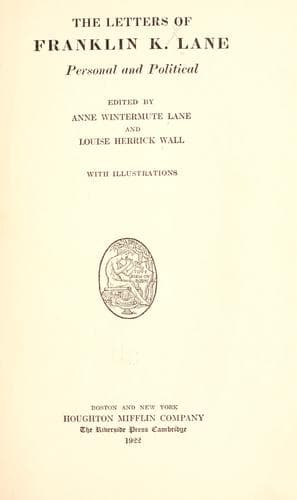
The Letters of Franklin K. Lane, Personal and PoliticalLane, Franklin K.
History
The Letters of Franklin K. Lane, Personal and Political
Lane, Franklin K.
United States -- Politics and government -- 1913-1921; World War, 1914-1918 -- United States
I heard a story from one of Joffre's aides. Joffre, by the way, is
the quietest, sweetest, most naive, and babylike individual I ever
met. All of the women, as well as the men, are in love with him.
When he met Nancy, at a garden party, he kissed her on both
cheeks. Nancy, as you may imagine, was ecstatically delighted.
This simple, grave, kindly soldier sat in his room while the
Germans came marching upon Paris, saying nothing. Every few
minutes an aide would come in and move the French markers back
upon the map, and the German markers forward, toward Paris. Day
after day he saw this advance, but said nothing. At last when they
came to the valley of the Marne, an aide came in and marked the
map, showing that the Germans were within thirty miles of Paris.
Then Joffre quietly said, "This thing has gone far enough," and
taking up a pad of paper he called to his troops to stand fast and
die upon the Marne, if necessary, to save France. There is nothing
finer than this in history.
Joffre has a skin like a baby. He has the utmost frankness and
simplicity of speech. When McAdoo asked him at the White House if
the present drive was satisfactory, he said in the most innocent
way, "I am not there." Viviani, who is the head of the French
Commission, is as jealous as a prima donna, terribly jealous of
Joffre, (which makes Joffre feel most uncomfortable) because, of
course, Joffre is the hero of the Marne.
I spoke at the Belasco Theatre the other day for the benefit of
the French war relief fund, introducing Ambassador Herrick and the
lecturer, a young Frenchman. Joffre and Viviani were in a box.
Every mention of the name of Joffre brought the people to their
feet. Yesterday I spoke again at a meeting of the State Councils
of Defense and I enclose you what the New York Post had to say.
Last night I dined with Balfour. I have seen quite a little of
him. He is sixty-nine years old and stands about six feet two. He
is a perfect type of the aristocratic Englishman, with a charming
smile. His real heart is in the study of philosophy. Anne sat next
to him at dinner and he told her that he believed in a personal
God, personal identity after death, and answer to prayer, which is
a remarkable statement of faith for one who has lived through our
scientific age. I think at bottom he is a mystic.
On all sides they are frank in telling of their distress. We did
not come in a minute too soon. England and France, I believe, were
gone if we had not come in. It delights me to see how much
sympathy there is with England as well as with France. The Irish
alone seem to be unreconciled with England as our ally.
Ned got your letter, and I suppose in time will answer it, I had
the question put to me by Baker yesterday as to whether I wished
him to go to the other side, and I had to say frankly that I did.
It was to me the most momentous decision that I have made in the
war. He has passed his final test, and I hope that he will get his
commission in a few days.
Public-domain text, read in full here on John Shaqi.
Reviews
Reviews
No reviews yet
Be the first to share your thoughts on this work.
Elsewhere in the archive
Join the Discussion
Join the discussion
Sign in to leave a comment or review.
Sign InorCreate an account