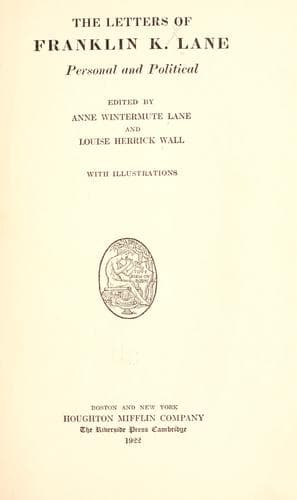
The Letters of Franklin K. Lane, Personal and PoliticalLane, Franklin K.
History
The Letters of Franklin K. Lane, Personal and Political
Lane, Franklin K.
United States -- Politics and government -- 1913-1921; World War, 1914-1918 -- United States
In the course of the evening Mr. Charles Glover, President of the
Riggs National Bank, told me this bit of history. That when he was
a boy, in the bank one day Mr. Cochran came to him and handed him
two warrants upon the United States Treasury, one for $1,400,000.
and the other for $5,800,000. He said, "Put those in the safe."
Mr. Glover did so, and they remained there for a week, when they
were sent to New York. Mr., Glover said "These warrants were the
payment of Russia for the Territory of Alaska. Why were there two
warrants? I never knew until some years later, when I learned the
story from Senator Dawes, who said that prior to the war, there
had been some negotiations between the United States and Russia
for the purchase of Alaska, and the price of $1,400,000. was
agreed upon. In fact this was the amount that Russia asked for
this great territory, which was regarded as nothing more than a
barren field of ice.
"During the war the matter lay dormant. We had more territory than
we could take care of. When England, however, began to manifest
her friendly disposition toward the Confederacy, and we learned
from Europe that England and France were carrying on negotiations
for the recognition of the Southern States, and possibly of some
manifestation by their fleets against the blockade which we had
instituted, (and which they claimed was not effective and merely a
paper blockade), we looked about for a friend, and Russia was the
only European country upon whose friendship we could rely.
Thereupon Secretary Seward secured from Russia a demonstration, in
American ports, of Russian friendship. Her ships of war sailed to
both of our coasts, the Atlantic and Pacific, with the
understanding that the expense of this demonstration should be met
by the United States, out of the contingent fund. It was to be a
secret matter. "The war came to a close, and immediately
thereafter Lincoln was assassinated and the administration
changed. It was no longer possible to pay for this demonstration,
secretly, under the excuse of war, but a way was found for paying
Russia through the purchase of Alaska. The warrant for $1,400,000.
was the warrant for the purchase of Alaska, the warrant for
$5,800,000. was for Russia's expenses in her naval demonstration
in our behalf, but history only knows the fact that the United
States paid $7,200,000. for this territory, which is now
demonstrated to be one of the richest portions of the earth in
mineral deposits."
TO HON. WOODROW WILSON
THE WHITE HOUSE
Washington, November 3, 1917
MY DEAR MR. PRESIDENT,--On April 7, 1917, the Council of National
Defense adopted a report, submitted by the Chairman of the
Executive Committee on Labor of the Advisory Commission of the
Council, urging that no change in existing standards be made
during the war, by either employers or employees, except with the
approval of the Council of National Defense. ...
The next step for producing efficiency must be no strikes.
Public-domain text, read in full here on John Shaqi.
Reviews
Reviews
No reviews yet
Be the first to share your thoughts on this work.
Elsewhere in the archive
Join the Discussion
Join the discussion
Sign in to leave a comment or review.
Sign InorCreate an account