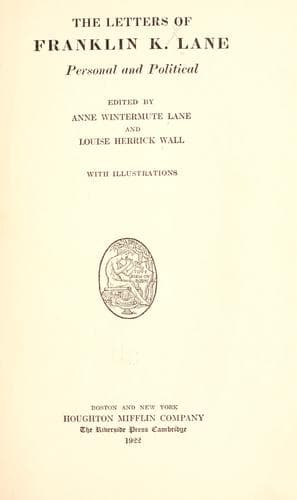
The Letters of Franklin K. Lane, Personal and PoliticalLane, Franklin K.
History
The Letters of Franklin K. Lane, Personal and Political
Lane, Franklin K.
United States -- Politics and government -- 1913-1921; World War, 1914-1918 -- United States
The work that is to be done, other than the planning, should be
done by the soldier himself. The dam or the irrigation project
should be built by him, the canals, the ditches, the breaking of
the land, and the building of the houses, should, under proper
direction, be his occupation. He should be allowed to make his own
home, cared for while he is doing it, and given an interest in the
land for which he can pay through a long period of years, perhaps
thirty or forty years. This same policy can be carried out as to
the other classes of lands. So that the soldier on his return
would have an opportunity to make a home for himself, to build a
home with money which we would advance and which he would repay,
and for the repayment we would have an abundant security. The
farms should not be turned over as the prairies were--unbroken,
unfenced, without accommodations for men and animals. There should
be prepared homes, all of which can be constructed by the men
themselves, and paid for by them, under a system of simple
devising by which modern methods of finance will be applied to
their needs.
As I have indicated, this is not a mere Utopian vision. It is,
with slight variations, a policy which other countries are
pursuing successfully. The plan is simple. I will undertake to
present to the Congress definite projects for the development of
this country through the use of the returned soldier, by which the
United States, lending its credit, may increase its resources and
its population and the happiness of its people, with a cost to
itself of no more than the few hundred thousand dollars that it
will take to study this problem through competent men. This work
should not be postponed. Cordially and faithfully yours,
FRANKLIN K. LANE
The bill, incorporating this plan, was rejected by a Congress
unwilling to accept any solution of any part of the after-war
problem, if the plan came from the Wilson Administration.
In 1918, Colonel Mears, who had been Chief Engineer and later
Chairman of the Alaskan Commission, in charge of the construction
of the Alaskan railroad, went, with many others, to the front, and
Lane was obliged to find new men to carry on the Alaskan work.
To Allan Pollok
Washington, July 17, 1918
You certainly can have more time, because I want you, and it is
not on my own account altogether, because I feel sure you will
delight in the kind of creative job that it is. I found that
Scotchmen had made Hawaii, and I would like to see some of that
same stuff go into Alaska. You see we have a fine bunch of men
there, practical fellows of experience, but not one of them looms
large as a business man or as a creator. I would personally like
to spend a few years of my life just dreaming dreams about what
could be done in that huge territory, and if I only got by with
one out of five hundred, I would leave a real dent in the history
of the territory.
Public-domain text, read in full here on John Shaqi.
Reviews
Reviews
No reviews yet
Be the first to share your thoughts on this work.
Elsewhere in the archive
Join the Discussion
Join the discussion
Sign in to leave a comment or review.
Sign InorCreate an account