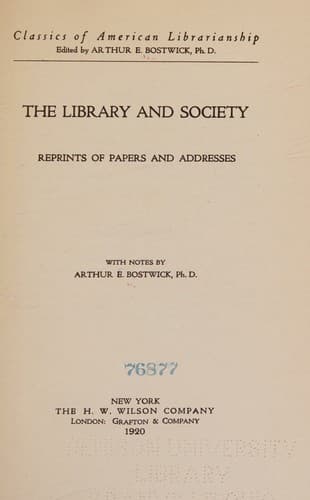
The Library and Society: Reprints of Papers and Addresses
History
The Library and Society: Reprints of Papers and Addresses
Libraries and society; Library science -- Social aspects
But to-day our honored city carries on and perfects her work. The
trustees, from their first annual report to the present time, have never
failed to recommend a first class public library, such as that, sir, for
whose accommodation you destine this noble building, as the completion
of the great system of public education. Its object is to give to the
entire population, not merely to the curious student, but to the
inquisitive member of either of the professions, to the intelligent
merchant, mechanic, machinist, engineer, artist or artisan, in short, to
all of every age and of either sex, who desire to investigate any
subject, either of utility or taste, those advantages which, without
such an ample public collection, must necessarily be monopolized by the
proprietors of large private libraries, or those who by courtesy have
the use of them; nay, to put within the reach of the entire community
advantages of this kind, far beyond those which can be afforded by the
largest and best provided private libraries.
The trustees are anxious that the institution, whose prosperity they
have so much at heart, should continue to be viewed in this light; as
one more added to the school-houses of the city, at which Boston boys
and girls, when they have outgrown the other schools, will come to carry
on the education which has been there commenced; where Boston men and
women, "children of a larger growth," may come to acquire that
additional knowledge which is requisite for the most successful
discharge of the duties of the various callings of society,--which
opens, in its pursuit, the purest sources of happiness,--and which,
without reference to utility, contributes so materially to the grace and
ornament of life.
I am aware that there is still floating about in the community a vague
prejudice against what is called book-learning. One sometimes hears
doubts expressed of the utility of public libraries; opinions that
they are rather ornamental than necessary or useful; and the fact that
our time-honored city, never indifferent to the mental improvement of
her children, has existed more than two centuries without one, is a
sufficient proof, that, until within a very few years, their
importance has not been practically felt. There is perhaps even now a
disposition to claim some superiority for what is called practical
knowledge--knowledge gained by observation and experience (which most
certainly the trustees would not disparage), and a kind of
satisfaction felt in holding up the example of self-taught men, in
supposed contradistinction from those who have got their knowledge
from books. No name perhaps is so frequently mentioned for this
purpose as that of Franklin, who, because he had scarce any school
education and never went to college, has been hastily set down as a
brilliant example to show the inutility of book-learning. It has been
quoted to me in this way, and to show that libraries are of no use,
within three days.
Public-domain text, read in full here on John Shaqi.
Reviews
Reviews
No reviews yet
Be the first to share your thoughts on this work.
Elsewhere in the archive
Join the Discussion
Join the discussion
Sign in to leave a comment or review.
Sign InorCreate an account