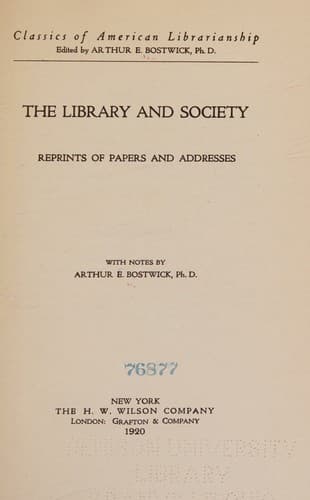
The Library and Society: Reprints of Papers and Addresses
History
The Library and Society: Reprints of Papers and Addresses
Libraries and society; Library science -- Social aspects
Then he made the acquaintance of Mr. Matthew Adams, an ingenious,
sensible man, "who had a pretty collection of books." He frequented the
printing-office, took notice of the bright little apprentice, and "very
kindly proposed to lend me such books as I chose to read." Having taken
to a vegetable diet at the age of sixteen, he persuaded his brother to
allow him in cash half the price of his board,--lived upon potatoes and
hasty pudding,--soon found that he could save half even of that little
allowance (which could not have exceeded two-and-six-pence a week,
lawful money), and this poor little economy "was an additional fund for
buying books." What would the poor, underfed boy, who was glad to buy
books on the savings of his potato diet, have said could he have had
free access to a hall like this, stored as it soon will be with its
priceless treasures?
Further, sir, while working as a journeyman in England, he says, "I
made the acquaintance of one William Wilcox, a bookseller, whose shop
was next door. He had an immense collection of second-hand
books."--(Somewhat, I suppose, like our friend Burnham, in
Cornhill.)--"Circulating libraries were not then in use, but we agreed
that on certain reasonable terms, which I have now forgotten, I might
take, read, and return any of his works. This I esteemed a great
advantage, and I made as much use of it as I could."
Finally, sir, as I have already said, Franklin's first important
movement for the good of his fellow-men was the foundation of the public
library in Philadelphia. At his instance, the members of a little club
to which he belonged, tradesmen and mechanics of narrow means, threw
into common stock the few books which belonged to them. A subscription
was then obtained from fifty young men, principally tradesmen, of two
pounds each, and ten shillings _per annum_, and with this little fund
they began. "The books were imported, the library was opened one day in
the week for lending them to the subscribers, on their promissory notes
to pay double the value if not duly returned." "This was the mother,"
says Franklin, "of all the North American subscription libraries, now so
numerous. It has become a great thing itself, and continually goes on
increasing. These libraries have improved the general conversation of
the Americans, made the common tradesmen and farmers as intelligent as
most gentlemen from other countries, and, perhaps, have contributed in
some degree to the stand so generally made throughout the colonies in
defence of their privileges."
Public-domain text, read in full here on John Shaqi.
Reviews
Reviews
No reviews yet
Be the first to share your thoughts on this work.
Elsewhere in the archive
Join the Discussion
Join the discussion
Sign in to leave a comment or review.
Sign InorCreate an account