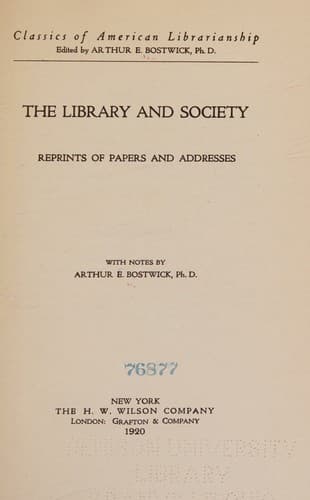
The Library and Society: Reprints of Papers and Addresses
History
The Library and Society: Reprints of Papers and Addresses
Libraries and society; Library science -- Social aspects
But it is time for me to conclude. The shades of evening are falling
around us; those cressets which lend us their mild and tasteful
illumination will soon be extinguished; and the first day of the
New-Year, rich in the happy prospects we now inaugurate, will come to a
close. May the blessing of Heaven give effect to its brightest
anticipations. A few more days,--a few more years,--will follow their
appointed round, and we, who now exchange our congratulations on this
magnificent New-Year's gift of our city fathers, shall have passed from
the scene; but firm in the faith that the growth of knowledge is the
growth of sound principles and pure morals, let us not doubt, that, by
the liberality of the city government and of our generous benefactors at
home and abroad, a light will be kindled and go forth from these walls,
now dedicated to the use of the FREE BOSTON PUBLIC LIBRARY, which will
guide our children and our children's children in the path of
intelligence and virtue, till the sun himself shall fall from the
heavens.
THE NEW YORK FREE CIRCULATING LIBRARY
ADDRESS IN ITS FAVOR AT A PUBLIC MEETING
President Cleveland made this address on March 6, 1890,
while a resident of New York City in the interval between
his two presidential terms, at a meeting, at Chickering
Hall, called for the purpose of directing attention to the
work of the struggling Free Circulating Library and if
possible to raise funds for its support, which was only
partially insured by the City. Owing to increase in both
public and private contributions this library was enabled to
make rapid growth in the years immediately following until
in 1901, when it was merged in the Circulation Department of
the New York Public Library, it was operating eleven
branches with a circulation of over 600,000. This
institution was the pioneer of the popular, as distinguished
from the scholarly, library idea in New York.
[Stephen] Grover Cleveland was born in Caldwell, N.J.,
March 18, 1837, the fifth son of a Presbyterian clergyman.
He received a common-school education and after his father's
death went in 1855 to live with an uncle in Buffalo, N.Y. He
was admitted to the bar there in 1859, was assistant
district attorney in 1863-66, sheriff in 1871-74 and mayor
in 1882. In the latter year he was elected Governor of New
York and in 1884 President of the United States. He was an
unsuccessful candidate for re-election in 1888, but was
elected again in 1892. He died in Princeton, N.J., where he
had resided since his last presidential term, on June 24,
1908.
Public-domain text, read in full here on John Shaqi.
Reviews
Reviews
No reviews yet
Be the first to share your thoughts on this work.
Elsewhere in the archive
Join the Discussion
Join the discussion
Sign in to leave a comment or review.
Sign InorCreate an account