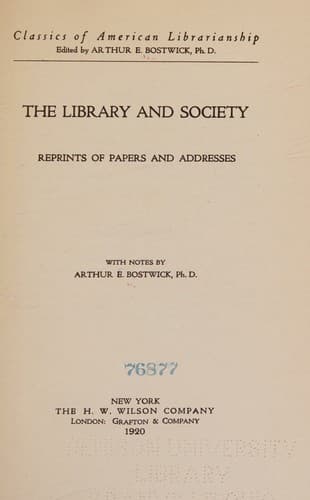
The Library and Society: Reprints of Papers and Addresses
History
The Library and Society: Reprints of Papers and Addresses
Libraries and society; Library science -- Social aspects
No one can speak too highly of the offices of a great library. It was
one of our great essayists, you remember, who said that the
monastery--speaking of it with reference to its books--was the ark that
floated down over the tempest and darkness of the middle ages, in order
to carry classic learning to the fifteenth century. They were
repositories of learning. That is the old idea. And for a long
time--almost to our day--that was the notion of the library. It was a
place to put something away. It was not even like a market for the sale
of provisions or eggs; indeed, if they were eggs the librarians thought
it their duty to sit on them, with the idea that they might hatch out
other books. That was a noble thing to do. But much better than that is
to scatter these books abroad among the people, so that we shall not
have reproduction--an egg for an egg--but that these books will so
revivify the life that we shall have books new, that express the actual
conditions and that appeal to the human life as it is. This is the
modern idea of the library. This great collection, which is not to be
secluded, is to be carried and even forced upon the people, so that it
shall enter into and become a part of their daily lives.
You remember, perhaps, what Milton says about the books, in that
noblest of noble defences of unlicensed printing, that "they are not
dead things. As good almost," he says, "kill a man as you kill a good
book. Who kills a man, kills a reasonable being, made in God's image.
Who destroys a good book destroys reason itself, kills the image of God
as it were, in the eye. Many a man," he goes on to say, "lives a burden
to the earth, but a good book is the precious life blood of a master
spirit, embalmed and treasured up on purpose to a life beyond life; so
that if we slay a good book we would slay immortality rather than a
life."
Charles Hopkins Clark, who immediately followed Mr. Warner,
was at this time editor in chief of _The Hartford Courant_,
of which Mr. Warner was co-editor. Mr. Clark was born in
Hartford April 1, 1848, graduated at Yale, and joined the
_Courant_ staff in 1871, becoming editor in 1890.
One of the earliest sins of my youth, or rather one of the earliest that
is burnt into my memory, was committed in the library of what was then
the Young Men's Institute. I spoke out loud! The rebuke that I received
sent me down the stairs overwhelmed with a sense of the enormity of my
crime, yet more than sustained by joy to think that I had escaped the
utter annihilation with which my reprimand was freighted. And I can say
that the awe with which I used to enter that chamber of silence, and the
fear with which I regarded the librarian were the common property of all
the young people of that somewhat remote period. But long since we found
out that the old librarian was one of the gentlest and most inoffensive
men, and that we had misunderstood him as completely as he had
misunderstood us.
Public-domain text, read in full here on John Shaqi.
Reviews
Reviews
No reviews yet
Be the first to share your thoughts on this work.
Elsewhere in the archive
Join the Discussion
Join the discussion
Sign in to leave a comment or review.
Sign InorCreate an account