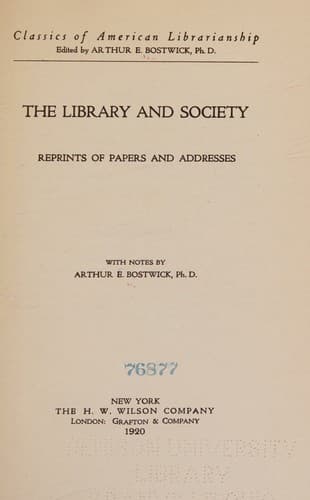
The Library and Society: Reprints of Papers and Addresses
History
The Library and Society: Reprints of Papers and Addresses
Libraries and society; Library science -- Social aspects
But a library, however perfect, and though freely open to all the world,
may be a light shining in a darkness which comprehendeth it not. Many
years ago, I was a student in such a library at Rome. It was larger than
any one in America at that time, and offered the best of all its stores
daily to everybody, and that without charge. Yet it was well-nigh a
solitude. The reason was obvious. My walk thither was through a gauntlet
of beggar-boys, and I once took with me an Italian primer, and cried out
that I would give something to any boy who could read. I held it up
before nineteen in succession, but no one could spell out a line. They
had eschewed not only writing as tempting to forgery, but reading also
as a black art. Had they been giants they could,--like the barbarians
who sacked Rome,--ruin, but not relish, the nectared sweets of books. To
them the collective wisdom of the world was as sunshine to the blind, or
as smoke in the nursery riddle,--"roomful, houseful, can't catch a
handful!"
"Or like gospel pearls which pigs neglect
When pigs have that opportunity."
But in regard to _our_ Free Library, I have better hopes, and beg your
leave to show _what use_, in my judgment, will be made of it. It will be
resorted to for _amusement_. Some will flit through it in the spirit of
the Viennese, who turn their central cathedral into a thoroughfare on
promenades and business walks. But such visitors will learn something in
glancing at the backs of books. Books, as well as men, have a
physiognomy. Here, as elsewhere, the admirers of Shakespeare will take
out his plays, return them with the leaves uncut, and then insist that
booksellers be instructed if Mr. Shakespeare writes any new book, to
forward it without further orders. Many will have no eyes except for the
volumes of _fiction_, and sometimes will rather run through these than
read them. Novels are a sort of cake, which, if eaten alone, is prone to
make mental dyspeptics. Yet most novel-readers will gain some profit
from our library. Some of them will here acquire a facility in reading
which for lack of practice has hitherto been unknown to them. No one has
really learned to read, until he has read to learn. Their interest in
stories will beguile the toil of becoming _ready_ readers, and their
range of reading will naturally widen. But if it does not, they may
learn much. Every good fiction is _true_, if not to particular fact yet
to general principles, to natural scenery, to human nature, to the ways
of human life, manners, customs, the very age and body of the time. Even
Tom Moore declares that "his chief work of fiction is founded on a long
and labourious collection of facts." Again, when worn out by work, when
care-crazed, and nerves are unstrung, who has not found in fiction--the
balm of hurt minds--a recreation, a city of refuge, a restorative.
"Cups that cheer but not inebriate?"
Public-domain text, read in full here on John Shaqi.
Reviews
Reviews
No reviews yet
Be the first to share your thoughts on this work.
Elsewhere in the archive
Join the Discussion
Join the discussion
Sign in to leave a comment or review.
Sign InorCreate an account