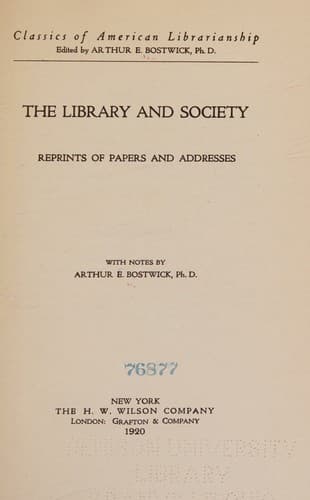
The Library and Society: Reprints of Papers and Addresses
History
The Library and Society: Reprints of Papers and Addresses
Libraries and society; Library science -- Social aspects
we, like the old prophet, should count the way-faring man a fool, and
how far he uses his license to lie. Hence they will read that they may
make up their minds whether all MARK TWAIN'S caricatures have the ring
of truth.
A German table d'hote of twenty courses will surfeit a careless diner
before it is half over, and yet fail to afford him either what he likes
best or what he should like best. Hence it compels guests to a careful
choice what they will partake of and what refuse of the blessing there
is no room to receive in its fulness. A similar influence will be
exerted by the free library where we fall into the embarassment of
riches. We shall be driven to select from its bill of fare, that is the
catalogue, that fraction which we can enjoy most and which will profit
us most.
"Taste after taste upheld by kindliest change."
Some persons, when they survey a library and perceive that they can
never read the hundredth part of its volumes, will be attracted to those
works which teach "what to read," or open a panoramic outlook on the
diversified regions of the bookish world.
"Of all the best of man's best knowledges,
The contents, indexes and title-pages,
Through all past, present, and succeeding ages."
Unless we thus liberalize our views we are likely to vegetate, like the
rhubarb pie plant, under a barrel, and see the world only through its
bunghole. Ignorant of bibliographical guides and hence at a loss how to
estimate books, the steward of a British nobleman sold as rubbish all
volumes in the library which lacked _covers_. One of those thus disposed
of, and bought by a pedlar for nine pence, proved to be the very
earliest issue of the British press, snapped up by the British museum
for £80, and could not now be bought for ten times that sum. In regard
to the _intrinsic_ value of books blunders more egregious are daily
made. Libraries were never so needful as now, for libraries and life
never lay so close to one another as now. Our familiar sights lead to
interest in recondite knowledge. Photography, gas, the locomotive,
kerosene, yes, every match that lights it, provokes questions in
chemistry, or philosophy, which not every library can answer. No one can
gaze at the dome of our Capitol without naturally falling into
architectural inquiries which draw him through a world of books that
expose the nakedness of his ignorance, yet never put him to open shame.
But the truth is too palpable to dwell on that in our day life touches
libraries at every point.
Public-domain text, read in full here on John Shaqi.
Reviews
Reviews
No reviews yet
Be the first to share your thoughts on this work.
Elsewhere in the archive
Join the Discussion
Join the discussion
Sign in to leave a comment or review.
Sign InorCreate an account