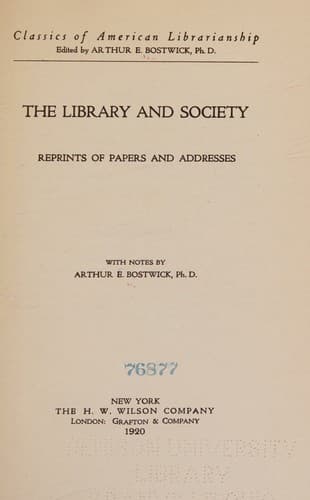
The Library and Society: Reprints of Papers and Addresses
History
The Library and Society: Reprints of Papers and Addresses
Libraries and society; Library science -- Social aspects
To some, however, a free library will make up for the lack of a liberal
education. More than that. It will furnish such an education every jot
and tittle of it, and that, in some sense, better than was ever bestowed
in a college, because acquired in the face of greater difficulties.
Libraries have often vouchsafed this priceless boon. That in Salem did
to BOWDITCH, the mathematician, in the last century, and to WHIPPLE, the
essayist, in this. The Edinburgh library made HUME an historian. Another
was inspiration to COBBETT. So was that of the Erfurt convent to LUTHER.
"It had purchased," says his biographer, "at heavy cost, several Latin
Bibles just printed for the first time in the neighboring city of Mainz.
When he first opened one of these tomes his eyes fell on the story of
HANNAH and SAMUEL. "O, God," he murmured, "could I have one of these
books I would seek no other worldly treasure." A great revolution then
took place in his soul. His happiest hours were in the library.
Concerning such a scholar--
"We cannot say: ''Tis pity
He lacks instructions,' for he seems a master
To most that teach."
The influence of ancient Libraries on classical writers is manifest from
their quotations. PLUTARCH'S have been traced to 250 authors. PLINY'S to
2,000 works. Classical Libraries preserved in Constantinople, so long as
studied, made there a Goshen of light in the Dark Ages, and when carried
to Italy proved a Promethean spark to kindle occidental culture anew. It
is well known that inventions are oftenest struck out in the Patent
Office, the grand store-house of inventions. In the world of mind, as
well as of matter, new ideas are suggested where old ideas most
congregate, or are most communed with. According to CHAUCER,
"Out of old fields, as man saith,
Cometh all the new corn from year to year,
And out of old books, in good faith,
Cometh all the new science that men lear."
The idea of writing the "Life of COLUMBUS" first darted into the mind
of IRVING, when, in Madrid, he found himself surrounded by an unrivaled
magazine of materials made ready to his hand, and for which the world
had been ransacked. Thus the sight of means to make good books makes
good books made.
Not only those volumes which compose the body of literature, but those
finer essences which form its soul,--the literature of power,--stamped
in Nature's mint of ecstasy--are marked all over with proofs of
familiarity with the best that had been achieved,--each in its own
department. Nobody has hesitated thus to affirm concerning VIRGIL,
DANTE, TASSO, MILTON. But it is commonly said that SHAKESPEARE was
_ignorant_. The truth is that no ignorant man, no ordinary, scholar can
understand his allusions, historical, romantic, classical, or those to
art, science, nationalities, customs--or even his words. He could get
more from a Library in a day than most men in a life-time, but he needed
it still.
Public-domain text, read in full here on John Shaqi.
Reviews
Reviews
No reviews yet
Be the first to share your thoughts on this work.
Elsewhere in the archive
Join the Discussion
Join the discussion
Sign in to leave a comment or review.
Sign InorCreate an account