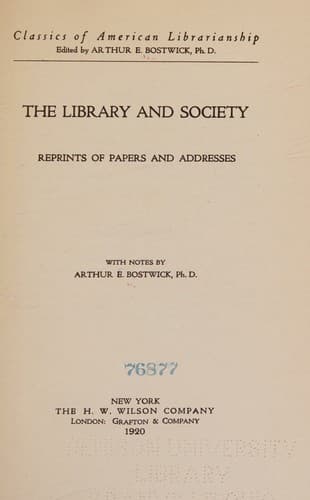
The Library and Society: Reprints of Papers and Addresses
History
The Library and Society: Reprints of Papers and Addresses
Libraries and society; Library science -- Social aspects
A library,--the assembled souls of all men deem most wise, the only men
who speak loud enough for posterity to hear;--reminds me of that fresco
by RAPHAEL, which I admired most of all his Vatican masterpieces,
popularly styled "The School of Athens," and which I hope to see hung up
as the genius of our library hall, as I have seen it in many. In some
one of the fifty-two figures glowing with life in that picture, every
variety of culture has a representative. You see there the practical
man, like FRANKLIN'S Poor Richard, in Diogenes rough and ready by his
tub. Archimedes is drawing a diagram in the sand. On the broad steps of
a temple stand Ptolemy, with the terrestrial and Hipparchus with the
celestial globe. No sage is without a docile retinue. SOCRATES, with sly
humor, is humbling the self-sufficient ALCIBIADES that he may rouse him
to loftier aspirations. PYTHAGORAS is writing among disciples, one of
whom holds his musical scale, while above all, and in the midst of the
temple, appear ARISTOTLE, father of natural philosophy, pointing down to
the earth, and PLATO, the father of spiritual philosophy with hand
uplifted toward heaven, man as it were feeling for God. The culture
proffered in such a School of Athens, as RAPHAEL painted--and as an
ideal free library is to my mind, has its fittest emblem in the miracle
of architecture, the dome,--which is well said to unite clustered arches
and pillars and radiate in equal expansion towards every quarter of the
earth, while with every convergent curve it soars heavenward, buried in
air, and looking to the stars.
"Simple, erect, severe, austere, sublime."
THE FREE PUBLIC LIBRARY
This section, devoted to the general relations of the
library and society, which opened with a historical account
by Prof. Moses Coit Tyler, may appropriately close with
another of similar tenor, contributed eleven years later to
_The American Magazine of Civics_ (New York, May, 1895) by
Prof. Henry H. Barber. It covers some of the same ground but
gives results to a later date, while it is still only
introductory to the social development of more recent years.
Henry Hervey Barber was born in Warwick, Mass., Dec. 30,
1835, graduated at Meadville Theological Seminary in 1861
and after holding several Unitarian pastorates was professor
of philosophy and theology there from 1884 to 1904. He was
also editor of the Unitarian Review from 1875 to 1884. He
died about 1915.
Public-domain text, read in full here on John Shaqi.
Reviews
Reviews
No reviews yet
Be the first to share your thoughts on this work.
Elsewhere in the archive
Join the Discussion
Join the discussion
Sign in to leave a comment or review.
Sign InorCreate an account