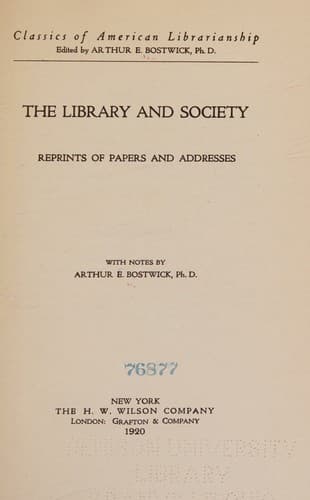
The Library and Society: Reprints of Papers and Addresses
History
The Library and Society: Reprints of Papers and Addresses
Libraries and society; Library science -- Social aspects
This library which Franklin started for the advantage of himself and his
fifty young business associates, in the early time, when, as he says,
"there was not a good bookseller's shop in any of the colonies to the
southward of Boston," and when most of the books had to be imported from
England, was followed soon by the establishment of more ambitious
similar libraries in Newport (1747) and Hartford (1774); and later in
many other places in England and this country. These were called public
libraries, though books could only be taken out by subscribers.
Probably, however, as in Philadelphia, the librarian could "permit any
civil gentlemen to peruse the books of the library in the library room."
But it was in the formation of many so-called "Social Libraries" in the
smaller cities and country towns of New England and the Middle States,
early in the present century, that the foundations of the free municipal
library were laid. These subscription libraries, in their growth and in
their decay, no less than in the appetite for books they developed,
created a demand and at length a necessity for public provision for what
had come to be one of the prime intellectual needs of many communities.
Meantime in Scotland, in 1816, Samuel Brown of Haddington, following in
part the methods of London booksellers, established a system of free
itinerating libraries, loaning without cost selections of fifty books in
each package to villages and neighborhoods that would engage to
circulate and take proper care of them. At the end of two years each
loan was called in, and another of different works sent in its place.
This scheme was for many years highly successful, and doubtless highly
useful; but seems to have failed soon after the death of its projector
and inspirer in 1839. The system had the earnest sanction of Lord
Brougham, and about 1825 was taken up in some parts of England; and, in
a modified form, has had a great success in Melbourne and its
neighborhood, in Australia. Stanley Jevons, whose article on the
rationale of free public libraries in his "Methods of Social Reform" is
one of the most interesting and valuable contributions to the literature
of this subject, commends it as the best form of extending free public
libraries in the rural portions of Great Britain, and he estimates that
there ought to be three thousand such literary itinerants in England and
Wales.
Public-domain text, read in full here on John Shaqi.
Reviews
Reviews
No reviews yet
Be the first to share your thoughts on this work.
Elsewhere in the archive
Join the Discussion
Join the discussion
Sign in to leave a comment or review.
Sign InorCreate an account