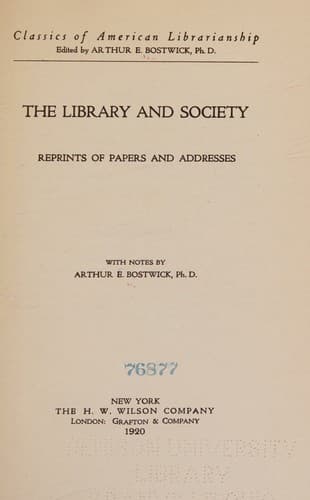
The Library and Society: Reprints of Papers and Addresses
History
The Library and Society: Reprints of Papers and Addresses
Libraries and society; Library science -- Social aspects
In 1849, New Hampshire passed a general law enabling towns and cities to
maintain free libraries by taxation; and in 1851 Massachusetts, which
had granted Boston in 1847 the right to establish such a library, passed
a similar general enabling act. Several other states followed almost
immediately, and nearly every northern and northwestern state, except
Pennsylvania, has since adopted the measure. In 1893, twenty states had
enacted similar statutes; and, in all, more than seven hundred free
libraries have been established under them. They have increased--as
might naturally have been expected--most rapidly in the portions of the
country where other library agencies, and where an efficient public
school system, have been longest and most efficiently at work. Thus, of
the seven hundred libraries, more than three hundred are in
Massachusetts (according to the returns of the Public Library Commission
for 1894), or 1,233 volumes for every thousand of population; in New
Hampshire something over one hundred (in 1894), or 464 volumes per
thousand of inhabitants.
Great Britain has kept nearly equal pace with our foremost states in
free library legislation. A general enabling act to establish and
support free libraries for the people from municipal rates was passed by
Parliament in 1850, and accepted with great energy and enthusiasm by
many of the northern towns and cities. Eighty-six free libraries, not
including branches, had been opened before 1880; but, as in this
country, the conservatism of the southern portions of the country has
prevented their general establishment. For similar reasons only the
province of Ontario has made any considerable movement in this direction
in the Dominion of Canada.
This hasty historical sketch would be very incomplete without some
account of the recent legislation, in several states, for the assistance
of the smaller towns and villages in the establishment and increase of
public libraries. This legislation has already had marvelous results.
Massachusetts, in 1890, appropriated one hundred dollars to any town
that would raise by taxation, or appropriate from the dog tax, or
otherwise raise, at least fifty dollars (or if its valuation was less
than one million dollars it should raise twenty-five dollars, or if less
than $250,000 it should raise at least fifteen dollars); and should
agree to take care of the books, and furnish the agency of distribution.
The sums granted by the state are in the hands of a board of
commissioners appointed by the governor (with the advice and consent of
the council); and so far these commissioners--librarians and
others--have been eminent citizens, serving without salaries, and having
only $500 in their hands annually for clerk hire and traveling expenses.
The commission is also required to give advice and information to
librarians and others concerning selection of books, cataloguing, and
administration; and to select and forward the books granted by the
state.
Public-domain text, read in full here on John Shaqi.
Reviews
Reviews
No reviews yet
Be the first to share your thoughts on this work.
Elsewhere in the archive
Join the Discussion
Join the discussion
Sign in to leave a comment or review.
Sign InorCreate an account