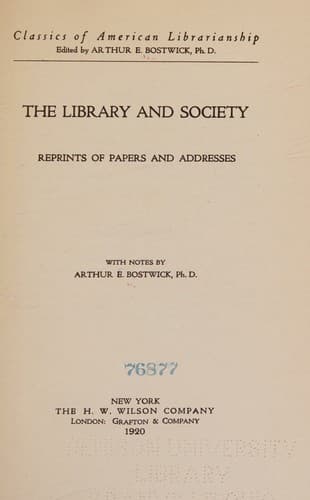
The Library and Society: Reprints of Papers and Addresses
History
The Library and Society: Reprints of Papers and Addresses
Libraries and society; Library science -- Social aspects
It is not strange that with this large and various capacity of social
service, the free library should be rapidly growing in public favor; nor
that private munificence should frequently come to the municipal
provision. There is no public object for which so generous gifts are
often made. In the year 1893, for instance, five hundred thousand
dollars were contributed to public libraries and the erection of library
buildings in Massachusetts alone. "There has been ready perception,"
says Fletcher in his "Public Libraries in America," "of the truth that
one's memory cannot better be perpetuated than by association with an
institution so popular and at the same time so elevating and refining as
the public library. Memorial libraries are therefore very abundant, and
as expense has not been spared in the erection of such memorials, many
of our towns, even the smaller ones, are ornamented by library buildings
which are gems of architecture.... The fact remains, with all its
significance, that about the public library cluster naturally the
affections and the interest of the community. In its endowment, on the
one hand by private beneficence, and on the other by public taxation, is
illustrated that collaboration of the rich and the poor in the pursuit
of the highest ends which has in it the promise, and perhaps the
potency, of the solution of vexing social questions."
The remembrance that these statements are only locally accepted, and
that large portions of England and the United States have hardly moved
toward the establishment of public libraries, may prompt a consideration
of certain objections which are still sometimes urged. Civilization
accepts its most benignant and effective agencies of progress only under
protest; and it is not, therefore, wholly inexplicable that fifty years
of unmixed and increasing success should have left some excellent and
otherwise intelligent people unconvinced of the beneficence of the free
public library. A friend of mine was enthusiastically setting forth the
advantages of such libraries, and their rapid multiplication and growing
service in New England, at the dinner table of one of the most
distinguished, philosophic, and progressive of contemporary Englishmen;
and was not a little surprised to be cut short with the decided comment,
"I do not believe in it." The Englishman's fastidious preference for
high fences and compartment railway carriages pervades all his
intellectual conceptions also; and makes him impervious even to Stanley
Jevons's overwhelming demonstration of the moral, social, and economic
utility of the free public library; impervious even to the appeal that
ignorance and narrow intellectual opportunity must be supposed to make
upon enlightened philanthropy.
Public-domain text, read in full here on John Shaqi.
Reviews
Reviews
No reviews yet
Be the first to share your thoughts on this work.
Elsewhere in the archive
Join the Discussion
Join the discussion
Sign in to leave a comment or review.
Sign InorCreate an account