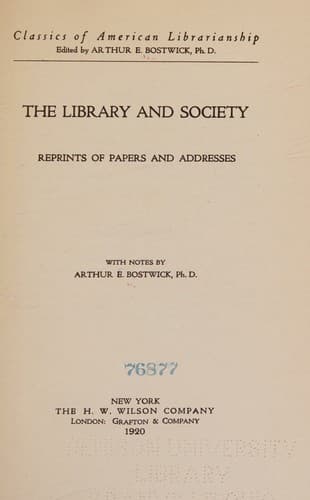
The Library and Society: Reprints of Papers and Addresses
History
The Library and Society: Reprints of Papers and Addresses
Libraries and society; Library science -- Social aspects
In the same way, it is to be hoped that these states will accompany
their enabling acts by auxiliary legislation similar to that in
Massachusetts and New Hampshire; or, perhaps still better, patterned
upon that of New York. It is difficult to decide upon the comparative
advantages of these two systems. That of Massachusetts seems to me
better for permanent results; but that of New York seems likely to be
more immediately effective in stirring the sluggish interest of
indifferent communities. Both are wonderfully economical in money, and
both have great effectiveness when worked by the intelligent interest of
even a few enthusiastic friends of the free library movement in any
community. It would seem that even a governor who thinks five million
people cannot afford $25,000 for the "Birds of Pennsylvania" might
consent to spend a fifth of that sum per year to begin a work that would
not end, if once well begun, without putting a new and most effective
agency of social culture and even economic progress within the reach of
every boy and girl in the state.
The machinery through which to plan and begin this great and hopeful
experiment should be carefully considered. Massachusetts's unsalaried
commission of eminent citizens, New York's Board of University Regents,
alike insure that in those commonwealths the work will be carried on
under the most hopeful and efficient conditions. Some such unpartisan
and public-spirited agency is absolutely demanded for the success of the
movement in a state that has to begin it _de novo_; and the _personnel_
of the agency is the most important point in any legislation initiating
it.
There is also a difference of opinion as to whether school boards, or
boards specially constituted for the purpose, should have charge of
public libraries. My opinion is decidedly in favor of the latter; for
while school boards would bring the library, as is most desirable, into
closer relation with the public schools, an independent board, chosen,
perhaps, by the school board in connection with the city council, as
sometimes in Massachusetts, would be likely to bring more ability,
independence, and careful consideration to the affairs of the library,
and to separate it more completely from injurious partisan and personal
politics.
THE COMMUNITY'S SERVICE TO THE LIBRARY
The Public Library, like the Public School, is the creature
of the community, which owes it provision for keeping it in
condition to render the service for which it was created.
This duty of course, includes adequate financial support but
does not end here. Among the most important adjuncts to such
support are the aid that can be given by enlightened public
opinion and by organized groups in the maintenance of
liberal and helpful policies, and the appointment of a
governing board equally conscious of its responsibilities
and its limitations.
THE RELATION OF THE STATE TO THE PUBLIC LIBRARY
Public-domain text, read in full here on John Shaqi.
Reviews
Reviews
No reviews yet
Be the first to share your thoughts on this work.
Elsewhere in the archive
Join the Discussion
Join the discussion
Sign in to leave a comment or review.
Sign InorCreate an account