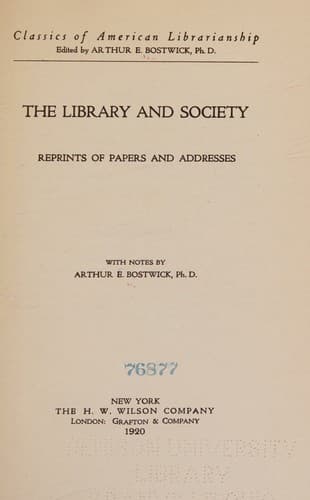
The Library and Society: Reprints of Papers and Addresses
History
The Library and Society: Reprints of Papers and Addresses
Libraries and society; Library science -- Social aspects
delicate enough to record the greater danger to the individual and the
State from poison in the great current, which has come to be a mighty
flood, of modern reading matter. The most hopeful, and perhaps the only
practicable, method of guarding against this serious danger is through
the public library, which must now in the last days of this eventful
century recognise the gravity of the new responsibility which it cannot
shirk. Before another audience I might dwell at length on what this
problem of selection means, but the representative librarians of the
world will understand my claim that, wonderful as was the development
from the cistern to the fountain, its importance is overshadowed by this
great question of excluding the pernicious, which I sum up in the word
filtration. This is the great problem of the modern library, and its
solution must depend largely on the State.
It is often said that the modern periodicals and newspapers are our
greatest danger; but this, of course, is true only of the sensational
and other objectionable types. I yield to none in my high appreciation
of what the best kind of newspaper may do in its capacity as the
strongest ally of the public library and of the public school. I am
confident that early in the next century such journals will be
recognised as a distinct part of our educational machinery, but I am
equally clear that the worst journals, conducted merely as money-making
enterprises, and catering to the worst instead of to the best elements
of both society and individuals, are the most potent factors for evil,
and the greatest enemy which the ideal librarian has to combat in
carrying forward his best work. They leave their habitual readers with
neither time nor taste for anything above their own low plane. The mind
will inevitably rise or fall to the level of its habitual reading, and
we apostles and missionaries of the book have no more disheartening
outlook than on the readers whose literary atmosphere is limited to the
modern sensational newspapers. But the apologists for such reading say
that the history of their own times is of more importance to them than
any other history; should they not, therefore, become as familiar as
possible with it? But when a man, on account of "pressure of business,"
never looks inside any good book, yet has time to read everything in the
newspapers, he is--well, specialising too much in "history." How many
men and women there are, who, from year's end to year's end, read
nothing but the so-called history of their own times, and who can tell
you nothing better than which dog won the last fight! It is a good thing
to know the history of our own times; so is a pinch of salt a good thing
on one's breakfast potato, but it is not necessary to drink a barrel of
sea water each morning in order to get it.
Public-domain text, read in full here on John Shaqi.
Reviews
Reviews
No reviews yet
Be the first to share your thoughts on this work.
Elsewhere in the archive
Join the Discussion
Join the discussion
Sign in to leave a comment or review.
Sign InorCreate an account