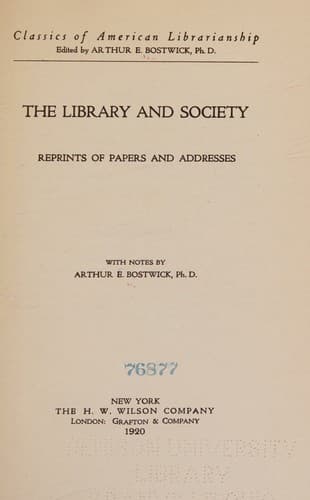
The Library and Society: Reprints of Papers and Addresses
History
The Library and Society: Reprints of Papers and Addresses
Libraries and society; Library science -- Social aspects
In this home education, which must hereafter be recognised side by side
with school education, the library is the great central agent round
which study clubs, reading circles, extension teaching, museums, and the
other allied agencies must cluster. A statesman solicitous for the
future welfare of his country will find his most fruitful field in
protecting and guiding the reading of the people. It is what a man reads
that shapes his future, which depends, not at once upon the rostrum and
the pulpit, but on the book and the newspaper. In education we recognise
that the supreme end is the building of character, but many of us have
never thought clearly how directly this character-building rests upon
the public library. It is reading that begets reflection, reflection
begets motive, motive begets action, and action begets habit, and habit
begets character; and who here dares question this, that it is not the
air nor the water, nor yet the "roast beef of Old England," not its
history nor traditions nor laws nor geographic location, but
_character_, that has made the Anglo-Saxons, England and her daughters
across the seas, the most wonderful people of the earth. It is not
brawn, but brain. The dogs and horses might have the physical qualities,
but it is the mind and soul, and those elements of true greatness which
can best be instilled into a people through the reading of good and
great books, that have made a race of which we are justly all so proud.
One of the wisest of Frenchmen said of the Franco-Prussian War, when the
needle-gun was suggested as the explanation of German victory, "No; it
was not the needle-gun, nor the German soldier who held it, nor yet the
German schoolmaster who trained the soldier, but it was the German
university that made the schoolmaster."
"Knowledge is power," and it is knowledge that has made England and
America great. Think of the men who read the poorest newspapers, but
know nothing of our best books. Can the State afford to make other
things free, and not make free true and useful knowledge as preserved in
books? Can the State recognize the necessity for free schools, and fail
to provide free access to the best reading in all realms of knowledge?
Public-domain text, read in full here on John Shaqi.
Reviews
Reviews
No reviews yet
Be the first to share your thoughts on this work.
Elsewhere in the archive
Join the Discussion
Join the discussion
Sign in to leave a comment or review.
Sign InorCreate an account