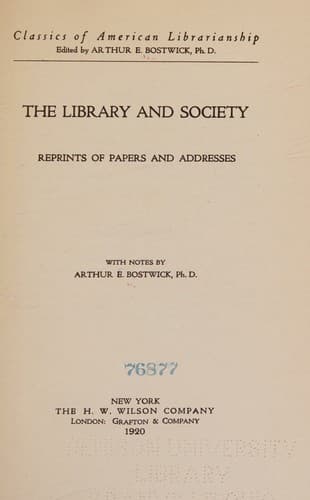
The Library and Society: Reprints of Papers and Addresses
History
The Library and Society: Reprints of Papers and Addresses
Libraries and society; Library science -- Social aspects
The State, whatever it may or may not do, should recognise the library
as being as essential to public welfare as is the school, and it should
give it as careful protection from dangers without and within as it
gives to institutions like banks and insurance companies. The State
should protect the library against unjust laws, improper interference,
or pernicious influence of any kind from without. It should guard it
also against misconduct, incapacity, or neglect on the part of its
trustees, officers, or employees. Beside the direct appropriations for
its support, it should grant the most liberal powers for holding
property given by individuals for the public benefit, and, above all,
should grant entire exemption from taxation. To tax a free public
library for doing its beneficent work is theorising gone mad. It is as
absurd as for a missionary to refuse admission to his preaching, or for
the manager of a theatre in which a fire has just started to shut out
every fireman till he had presented the conventional coupon for a
reserved seat. The example first set by my own State (New York) in the
statute which I had the honour of drawing ought to be followed
universally. We created a public libraries department, to devote its
entire attention to advancing the best interests of public libraries. It
would take the entire morning to sketch to you the various forms of
beneficent work which we have found practicable. We help to establish
new libraries, reorganise old ones, revise methods, select books, lend
single books or entire libraries, grant books or money up to $200 yearly
to any library raising an equal sum from local sources, and, by means of
correspondence, personal inspection, and steady work in a dozen
directions, help every community to get the greatest practical good from
the labour and money given to its free library. We have now about five
hundred travelling libraries moving about in all parts of the State. The
public library is rapidly becoming universal. For the Government not to
recognise it in its own organisation is as absurd as it would be to have
a standing army and no war department, or schools dotted all about the
state and no department of education. Time forbids more than the mere
naming of what is needed, but the first great step in summing up the
relation of the State to public libraries is the establishment of a
public libraries department, in charge of a strong man who appreciates
the almost limitless opportunities for usefulness which this new field
affords.
Public-domain text, read in full here on John Shaqi.
Reviews
Reviews
No reviews yet
Be the first to share your thoughts on this work.
Elsewhere in the archive
Join the Discussion
Join the discussion
Sign in to leave a comment or review.
Sign InorCreate an account