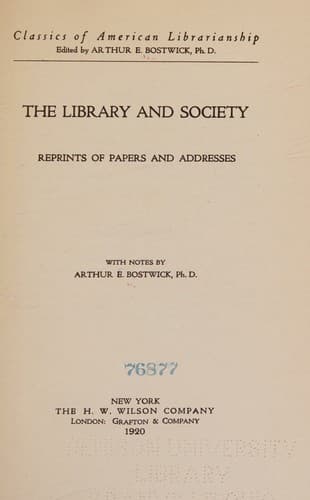
The Library and Society: Reprints of Papers and Addresses
History
The Library and Society: Reprints of Papers and Addresses
Libraries and society; Library science -- Social aspects
The question, "What does the public want?" is not the only, nor, in
fact, the chief question to be borne in mind in the conduct of a
library. One has only to keep his eyes open to see how suggestive as to
methods is this other question: "Of what service may the library be?"
And it is safe to say that one who has not given the subject attention
will be surprised to find at how many points a collection of books, and
the thought there contained, touch human life. Here is a machine-shop
with its hundred or more workmen, many of whom are anxious to study some
mechanical work. The library has such works, and is glad to supply them.
Here again is a society of natural history, whose members are
systematically studying some department of natural science. To them,
also, the library willingly offers its resources in that department.
With no less willingness it offers its cooperation to those who are
following a course of public lectures on some topic of political science
or of art, to a college class studying topically some epoch of history
or period of literature; or to a public-school teacher, with a class in
geography; or a parent desiring some suitable reading for a child. Or,
with no specified class of persons in view, it seeks to make its
collection generally available, by regular references to its resources
on matters of current and universal interest.
Much more effective, however, than the best of such attempts at reaching
classes of readers will be the aid rendered to individual readers. Not
general and indefinite, but specific and direct assistance, is here
given, and, although at first this kind of work might seem to be
impracticable in a large library, yet one who tries it will be
interested to see how far such individual methods may be introduced. The
librarian almost mechanically learns "to pigeon-hole" in his mind the
peculiar tastes and lines of reading of single readers, and, when the
occasion presents itself, can bring to their notice books and articles
which they are glad to obtain. More than one librarian makes it a
regular practice, in adding new books to the library or in collecting
material bearing upon some one topic, to drop a postal to this and that
reader who, he knows, will be glad of just this information. The more
the conducting of a library can be made an individual matter, bringing
particular books to the notice of particular readers, the more effective
it becomes.
It remains to consider what may be called the "general effect" of such
individual efforts, continued from one year to another. They will
certainly result in giving the public a large amount of assistance.
Being exerted in connection with the whole community, they cannot fail
to leave an influence, like the school, the church, or the
newspaper,--an influence moreover, which, if wisely directed, and
intelligently shaped, will make the public library idea appreciably felt
in the civilization of the country.
Public-domain text, read in full here on John Shaqi.
Reviews
Reviews
No reviews yet
Be the first to share your thoughts on this work.
Elsewhere in the archive
Join the Discussion
Join the discussion
Sign in to leave a comment or review.
Sign InorCreate an account