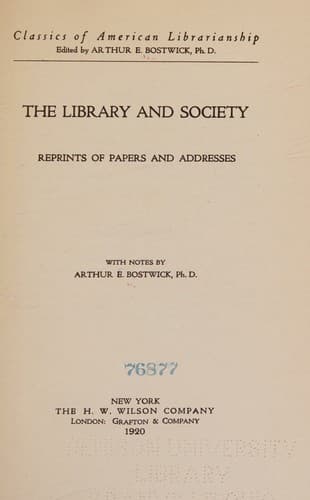
The Library and Society: Reprints of Papers and Addresses
History
The Library and Society: Reprints of Papers and Addresses
Libraries and society; Library science -- Social aspects
A Free Library may be defined as the socialists' continuation school.
While State education is manufacturing readers for books,
State-supported libraries are providing books for readers. The two
functions are logically related. If you may take your education out of
your neighbour's earnings, surely you may get your literature in the
same manner. Literary dependency has the same justification as
educational dependency; and, no doubt, habituation to the one helps to
develop a strong desire for the other. A portion of our population has
by legislation acquired the right to supply itself with necessaries and
luxuries at the cost of the rates. The art of earning such things for
themselves has been rendered superfluous. Progress therefore halts
because this all-important instinct has fallen into disuse. At a point
the rates will bear no more, and those who depend on them for their
pleasures are doomed to disappointment. The identity of principle
exemplified alike by compulsory education and compulsory libraries,
logically involves the justification or condemnation of both; and, let
us disguise the unpleasant truth in as many sounding phrases as we
please, the fact remains that the carrying out of this socialistic
principle means pauperism pure and simple. Have we forgotten the evils
that resulted from the application of this principle under the old poor
law? or do we imagine that when an evil changes its outward appearance
it changes its inner essence also? The harm done to the national
character by a policy of this nature varies in intensity in proportion
to the necessity of the want supplied. If the thing supplied at public
cost is really necessary and eagerly accepted by the people, it becomes
more readily a potent cause of dependency, and a heavy and at length an
insupportable charge on the ratepayers. This was the experience of the
old poor law. The cost of national education is fast approaching to the
same state of things, and the problem will one day have to be faced:
'How is the burden of the cost of education to be returned to the
shoulders of those who are responsible for it?' In this paper we are
concerned with a smaller question. A very inconsiderable section of the
people really want the Free Library; the question at the polls is
generally treated with apathy, and only a very small proportion of the
ratepayers record their votes one way or the other. As a matter of fact
the Free Library is forced upon the public by a number of doctrinaire
believers in the superhuman value of a mere literary education. It is
not a popular want. The vast majority of people have still a greater
faith in the training which results from practical contact with the real
facts of life, and still only regard book-learning as a useful
supplement, easily obtainable by those who really desire it and are
likely to profit by it.
Public-domain text, read in full here on John Shaqi.
Reviews
Reviews
No reviews yet
Be the first to share your thoughts on this work.
Elsewhere in the archive
Join the Discussion
Join the discussion
Sign in to leave a comment or review.
Sign InorCreate an account