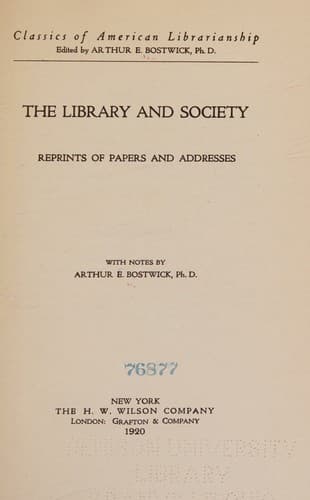
The Library and Society: Reprints of Papers and Addresses
History
The Library and Society: Reprints of Papers and Addresses
Libraries and society; Library science -- Social aspects
are here complete, and each play is accompanied by the poem, story, or
previous play on which it is founded. Here, for example, is the last of
the series as yet published, 'All's Well that Ends Well'; it contains a
translation of the story of Giletta of Narbona from Painter's 'Palace of
Pleasure'; it is worth threepence to a student, if only for showing the
difference between raw material and finished product. Hundreds of new
novels, including some of those of Thackeray, Kingsley, Dickens, Lytton,
and other well-known authors, are to be obtained in most places for
4-1/2_d._, and their secondhand price is less still. Considering the
marvellous cheapness of good books, it is difficult to understand how
any one can either blackmail his neighbour for them, or encourage
working-men to do so. If a man will not deduct a few coppers now and
then from his outlay in other luxuries to purchase literature, he cannot
want literature very badly; if he does not value books sufficiently well
to buy them with his own earnings he does not deserve to have them
bought for him with other people's earnings. That poor women and others,
who are often the sole support of a large family of children, should
have their hard earnings confiscated to maintain readers--many of them
well-to-do--in gratuitous literature, is an injustice not to be
palliated by all the hollow cant about culture and education so freely
indulged in at the present time. Some time ago there was a discussion on
'the sacrifice of education to examination.' There is another question
quite as serious--the sacrifice of justice to so-called education.
Let us next consider the educational value of this institution.
It is hardly necessary for us to say that we have no objection, either
for ourselves or for our neighbours, to novel-reading. On the contrary,
we regard it as a legitimate form of recreation. All we argue is that it
is not a luxury which should be paid for out of the rates. Now, to
listen to the advocates of Free Libraries one would imagine that these
institutions were only frequented by students, and that the books
borrowed were for the most part of a profound and scholarly character.
But the very reverse of this is the case. The committee of the Blackpool
Free Library, in their Report for the year 1887-8, say:--'Works of
fiction and light literature enjoy the greatest degree of popularity,
each book circulating eleven times in the year, while _the more
instructive books in the other classes circulate only once during the
same period_.' According to this Report, out of a total average daily
issue of 150 volumes, 137 are works of fiction and light literature. The
average issue of history, which is the next largest item, is only 9 per
diem.
Public-domain text, read in full here on John Shaqi.
Reviews
Reviews
No reviews yet
Be the first to share your thoughts on this work.
Elsewhere in the archive
Join the Discussion
Join the discussion
Sign in to leave a comment or review.
Sign InorCreate an account