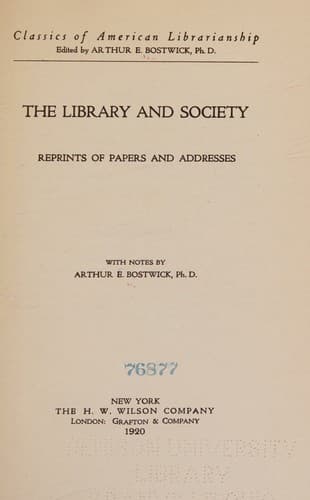
The Library and Society: Reprints of Papers and Addresses
History
The Library and Society: Reprints of Papers and Addresses
Libraries and society; Library science -- Social aspects
The half-century of discussion of "socialism and socialistic
legislation" already referred to has made few things so clear as the
fact that the arguments employed on any subject--social subjects in
particular--are weakened in almost the exact ratio in which they are
allowed to be tinged by passion and excited feeling. It must therefore
be regarded as unfortunate that Mr. O'Brien's chapter suffers most
emphatically from comparison with the generally high level of calm and
unimpassioned argument, characterizing the larger portion of the book.
Whether this is to be explained on the basis of the apocryphal legal
maxim, "When you have no case, abuse your opponent," or whether Mr.
O'Brien entered the lists fresh from some too recent participation in a
personal contest over the question, we do not undertake to inquire. The
fact remains that not only do the writers of the other chapters of the
book appear from a careful reading to state their arguments more
effectively, but that the reader is also impressed with the fact that
they have a case which admits of more effective argument.
Let us glance in succession at the points which Mr. O'Brien has aimed
to make. They may be grouped in general under two heads; first, those
which relate to the injury (in Mr. O'Brien's view) inflicted on the
individual user of a free library from having it aided by public
support, and second, those which relate to the tax-payer's grievance (in
Mr. O'Brien's view) in helping to support it. The former is of course
the side of the question most germane to the general purpose of the
book, and it is therefore an occasion for surprise to notice that in Mr.
O'Brien's enumeration of arguments those coming under the other class
outnumber it in the ratio of six to one. First of all, to use Mr.
O'Brien's own language "the argument that if readers were left to pay
for their own books, not only would books be more valued, but the moral
discipline involved in the small personal sacrifice incurred by saving
for such a purpose would do infinitely more good than any amount of
culture obtained at other people's expense." And he takes occasion to
suggest that "possibly the advocates of literary pauperism will see
little force in" this argument. Possibly; we are not familiar with the
train of reasoning which leads to an advocacy of "literary pauperism."
For ourselves, we have been accustomed, long before the appearance of
Mr. O'Brien's chapter, to attach exceptional importance to the principle
which he has here indicated, somewhat awkwardly, to be sure. There can
be no doubt that the appreciation of any object is in almost the exact
ratio of the effort expended to procure it. This is why teachers and
librarians--in American communities, at least--have so often had
occasion to rejoice at seeing a taste not only for reading, but for
owning books inspired in a young man or woman by access to a noble
collection of books for the use of the public. For "owning books," we
Public-domain text, read in full here on John Shaqi.
Reviews
Reviews
No reviews yet
Be the first to share your thoughts on this work.
Elsewhere in the archive
Join the Discussion
Join the discussion
Sign in to leave a comment or review.
Sign InorCreate an account