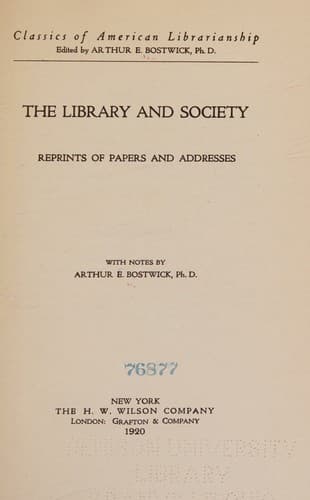
The Library and Society: Reprints of Papers and Addresses
History
The Library and Society: Reprints of Papers and Addresses
Libraries and society; Library science -- Social aspects
No aspect of the library's operation is more full of interest than
that which takes account of its uplifting influence. The analogy between
its service and that of the postal system has been noticed; but it has a
no less real analogy to the work of the school, the pulpit, or the
press--yet without the propagandist principle which so often attaches to
these latter--namely, in the principle of growth or advance. In the
earlier portion of this paper a little space was devoted to showing that
in the nature of the case the number of copies of any work of fiction
used in the course of a year would immensely out-number those which
could possibly be read in the more solid departments of reading. Even
were the constituency of the library confined to a selected few, to
whose minds the higher class of reading was congenial, this would be the
case. Nor should we forget that the ground of distinction between a
"public" library and any other, as the library of a scientific society,
a debating society, a theological school or a teachers' club, is that
its constituency _is_ not thus limited to a selected class but is broad
as humanity itself, with all its enormous inequalities of condition,
taste, and mental growth. Like a mirror, therefore, the recorded
classified circulation reflects this variety. Even with this apparently
almost unmanageable unevenness, appreciable improvement in standards of
reading is by no means an unknown experience. There lies before the
writer, for instance, a library report which is able to make such a
statement as this: "The fiction percentages of the seven successive
years, beginning with 1883 and ending with 1889, show an uninterrupted
decline, as follows: 70+, 66+, 62+, 61+, 58+, 56+." But it must be
remembered also that figures such as these, though they may tell a part,
and a very gratifying part, of the advances which individual readers
have been helped to make, fall very far short of expressing the whole.
It would be entirely possible for individual after individual thus to
advance from good to better, and from better to best, and yet the
figures which express the aggregate use of the year remain stationary
(or even retrograde), because the constituency of a public library
(particularly in a large city) is all the time being reenforced by new
readers. And these new readers comprise both those who are children in
age and those who are children in mental growth, who begin at the foot.
When, therefore, there is anything more than a preserving of a uniform
level--as in the noteworthy figures above quoted--it stands for a very
striking advance indeed, on the part of a very large portion of the
community. Probably every librarian in charge of a public library in a
large city has had an opportunity of observing these advances in
innumerable individual instances. And this class of results, while
distinctly following the "order of nature," does not by any means come
about through a view of library administration which regards either
Public-domain text, read in full here on John Shaqi.
Reviews
Reviews
No reviews yet
Be the first to share your thoughts on this work.
Elsewhere in the archive
Join the Discussion
Join the discussion
Sign in to leave a comment or review.
Sign InorCreate an account