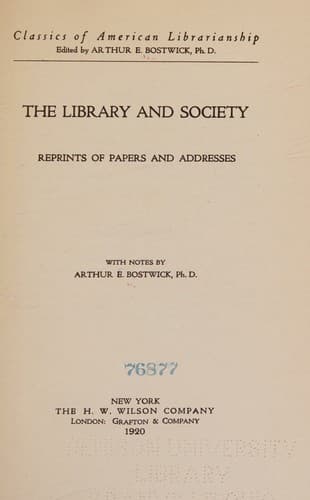
The Library and Society: Reprints of Papers and Addresses
History
The Library and Society: Reprints of Papers and Addresses
Libraries and society; Library science -- Social aspects
community in an almost ideal relation, not only fulfilling very
perfectly Mr. Carlyle's characterization of a "collection of books" as
"the people's university," but in the peculiarly wide range shown in the
demands made upon it, almost as properly rendering it the people's
workshop, or laboratory.
The same library report which has several times been cited printed
several years since a record of the inquiries made on specific subjects
during a single month, which throws significant light upon this subject.
Another report of the same library declares that "few can adequately
conceive to what extent the inquiries made at the library have become
specialized, and require trained facility and research" on the part of
the library staff. The library thus becomes a laboratory, in which the
reader gains not only the specific information, but the method.
An observation of popular movements in their relation to political or
economic principles reveals few facts so plainly as that an almost
insuperable narrowness of view is, in much the greater number of
instances, the barrier to advance in those questions decided mainly by
the popular voice. Why then should any one wish to perpetuate the
conditions which make this possible? In Mr. O'Brien's view the
workingman,--and we ought not to forget how large a percentage of the
community this word "workingman" represents, both in England and
America,--will be a fortunate man when the contents of free libraries
are no longer rendered everywhere accessible to him by public support,
for then the workingmen "for one 'penny' can buy their favorite
newspaper, which can be carried in the pocket and read at any time"! It
is well nigh incredible that an ideal such as this should be looked
forward to by thinking men. Whatever may be the fact in regard to the
workingmen of Great Britain,--and Mr. O'Brien of course knows them
better than we do,--it may confidently be asserted that the American
workingman would strike no such false note. Mr. Lowell in one of his
admirable orations quotes from a Wallachian legend of a peasant who was
"taken up into heaven" and offered his choice among the objects to be
seen there. He chose a half worn-out bagpipe, and with this returned to
the earth. "With an infinite possibility within his reach, with the
choice of wisdom, of power, of beauty, at his tongue's end, he asked
according to his kind, and his sordid wish is answered with a gift as
sordid." The newspaper is well enough in its way,--even a "penny
newspaper,"--but to condemn whole masses of the population to limit
themselves to this, is to incur the condemnation of Mr. Lowell's fine
scorn when, in another portion of the oration just referred to, he says:
"It is we who, while we might each in his humble way be helping our
fellows into the right path, or adding one block to the climbing spire
of a fine soul, are willing to become mere sponges saturated from the
stagnant goose-pond of village gossip." It is more. It is to help
Public-domain text, read in full here on John Shaqi.
Reviews
Reviews
No reviews yet
Be the first to share your thoughts on this work.
Elsewhere in the archive
Join the Discussion
Join the discussion
Sign in to leave a comment or review.
Sign InorCreate an account