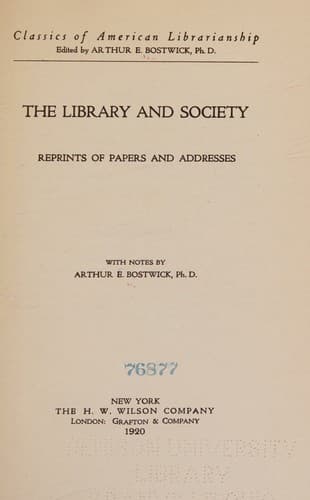
The Library and Society: Reprints of Papers and Addresses
History
The Library and Society: Reprints of Papers and Addresses
Libraries and society; Library science -- Social aspects
(7) Similar comparisons with the six smaller cities listed would give
results generally similar, but showing a still more liberal rate per
head and dollar of expenditure for libraries.
In addition to this exposition of comparative parsimony a feature of it
should be remembered which might easily escape notice: that, while the
money for running expenses is all gone at the end of the year, nearly
all of the allowance above running expenses remains represented by
valuable property. Thus, if the year's allowance for this library had
been $28,000, instead of $18,000, it would not have cost a cent more to
run the library and at the year's end about $10,000 worth of books would
remain added to the permanent property of the city.
Another result of this policy is to prevent printing any catalogue of
the recent additions to the library; so that there is practically no
access, and there will, for the present, continue to be none, even for
the public who own the books, to all additions to this library since
June, 1884, being several thousand titles. It is needless to point out
that if there were to be the hypothesis of an unfriendly purpose
entertained against the library, that purpose would be served as
directly by suppressing the names of books in the library as by
preventing the addition of new ones, or by the replacing of those worn
out.
These brief statements sufficiently show what our city is doing, and
what other cities are doing, for or against public libraries. It is not
within the scope of this paper to inquire after the real reason for the
stop put to the progress of the San Francisco Free Public Library. One
hypothesis is, that, instead of any unfriendly intention against the
library itself, the step was taken to help in persuading the public that
the "dollar limit" to the rate of city taxation is too low, and that our
citizens must submit to a higher rate. As the money saved is only
$6,000, the economy is not great in itself, being about one
four-hundredth part of the city tax levy. If the proposed effect was
expected to be produced by continuously annoying and dissatisfying the
citizens there is more reason in the scheme; for the library is
frequented by more than a thousand persons daily; between 26,000 and
27,000 cards have been issued to authorize the home use of books; and
there are always at any given moment from 5,900 to 6,000 volumes from
the library in use in as many homes all over the city. To inconvenience
and disoblige so large a constituency as this may naturally produce some
effect. This paper need not attempt to decide whether that effect would
naturally be approval or disapproval of the treatment of the library,
enthusiasm in favor of, or against, the proposed increase of taxation,
unpopularity or popularity of the institution itself, or of those whose
action so effectually cripples its usefulness. Nor will it discuss the
still larger question of the "dollar limit" itself,[4] however
Public-domain text, read in full here on John Shaqi.
Reviews
Reviews
No reviews yet
Be the first to share your thoughts on this work.
Elsewhere in the archive
Join the Discussion
Join the discussion
Sign in to leave a comment or review.
Sign InorCreate an account