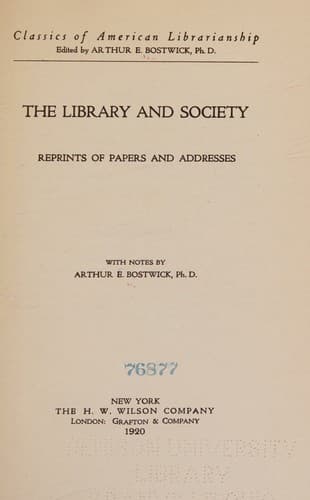
The Library and Society: Reprints of Papers and Addresses
History
The Library and Society: Reprints of Papers and Addresses
Libraries and society; Library science -- Social aspects
Fifth. There is another department of usefulness for public libraries,
quite unknown until within a few years, which makes them actual and
vital members of the public-school system, and additionally justifies
the term "People's Universities," which has often been applied to them.
This is the arrangement at the library of courses of illustrative study
and reading for teachers or pupils, or both. A series of such books as
relate to one or another part of the school course is laid out at the
library; the teachers, and perhaps sometimes one of the higher classes,
examine them along with the librarian, and such information as they
afford is used to fill out and illustrate the outline in the school-book
for the fuller information of the pupils.
This practice is perhaps easiest in history and geography. It is easy to
see how a capable teacher could intensify the interest and enrich the
minds of a class about the geography of the East Indian archipelago, by
introducing them to the vivid narrative and abundant illustrations of
Wallace's most entertaining and instructive book on that region. How,
for instance, Palgrave's "Year in Arabia," Palmer's "Desert of the
Exodus," Lady Duff Gordon's "Letters from Egypt," O'Donovan's "Merv
Oasis," Atkinson's and Kennan's books on Siberia, Huc's "Travels in
Tartary and in China," and hundreds of other books, each for its
locality, all over the world, could be used to give a child clear
notions and strong impressions of savage or civilized landscapes and
people. It is not too much to say that the study of geography in the
public schools of San Francisco, illustrated as it could easily be from
books of travel now in the public library, could be made from beginning
to end as fascinating as any romance, while it would store the
children's minds with a kind and quantity of distinct knowledge about
the earth and its people as much beyond the results of ordinary
geographical study as gold is better than mud. It would be easy to
furnish similar specifications for the study of history, of natural
science, and other branches. This is no mere speculation. This system of
instruction is regularly practised by Mr. Green, of the Worcester Free
Library (the originator and pioneer in it); by Mr. Poole at Chicago, and
elsewhere, and with complete success. Besides its immediate result in
vivifying and enriching the pupil's minds, this method affords a
training in habits of reading of the very best kind, by teaching
research, the habit of selecting books, and the practice of comparative
thinking.
To sum up: A free public library--
1. As to manners--is a parlor, not a bar-room; a place where not only
working men and business men, but ladies and young girls can safely and
conveniently come and abide. While not expressly a school of manners and
morals, it is much and closely concerned in maintaining a high standard
in both.
Public-domain text, read in full here on John Shaqi.
Reviews
Reviews
No reviews yet
Be the first to share your thoughts on this work.
Elsewhere in the archive
Join the Discussion
Join the discussion
Sign in to leave a comment or review.
Sign InorCreate an account