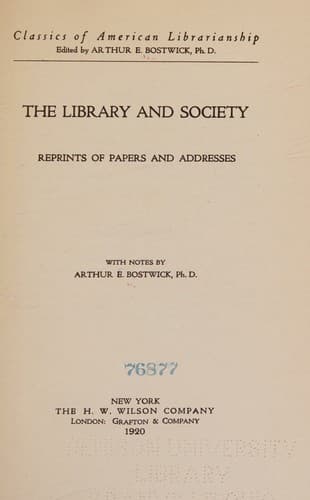
The Library and Society: Reprints of Papers and Addresses
History
The Library and Society: Reprints of Papers and Addresses
Libraries and society; Library science -- Social aspects
Then organized society can truthfully say to the individual, in the
language of Professor Hoffman in his "Sphere of the State": "We have
done what we could to develop and strengthen all your powers. We have
taught you to the best of our ability to know yourself and to understand
your relations to your fellows. Now, so long as you conduct yourself as
a child of the day and not of the night, all the rights and privileges
of the brotherhood are yours. But if you choose to walk in the darkness
rather than in the light, if you trample under foot our laws, if you
raise your hand against every man, let the curse of your wrong doing
fall upon your own head, not on ours."
ALTERNATIVES TO TAX-SUPPORT
In the case of a public library, that is, of one intended to
be used by all the members of the community, as
distinguished from a subscription library, alternatives to
public support have usually been in the nature of expedients
to tide matters over until the library could be turned over
to the municipality. The next two papers are early
discussions of some of these alternatives.
IF NOT A TAX-SUPPORTED LIBRARY, WHAT?
The following paper contributed anonymously to _The Iowa
Library Quarterly_ (Des Moines, April, 1903) tells how local
library associations have been formed in that state, in
small towns where public support, for the moment, has been
deemed impossible or inadvisable.
The fact that a majority of the states of the Union have by legal
enactment provided for free public libraries supported by tax indicates
the general acceptance of the belief that such an institution is for the
public good and its support as an educational institution is as
desirable as the support of the public schools.
More and more has it come to be recognized that if the ideals and
aspirations of youth are to be aroused and directed early in life by the
reading of inspiring books, the state may well foster this institution
which provides such literature.
The Code of Iowa provides that towns and cities shall have power to
provide for the foundation and maintenance of a free public library by
voting upon the question, "Shall a free public library be established"
at a general or special election, and further providing that a tax not
exceeding two mills on the dollar of the taxable valuation of such city
or town may be levied for its support. This places the library on a firm
footing as a public educational institution, even though its income from
the tax may be small.
Public-domain text, read in full here on John Shaqi.
Reviews
Reviews
No reviews yet
Be the first to share your thoughts on this work.
Elsewhere in the archive
Join the Discussion
Join the discussion
Sign in to leave a comment or review.
Sign InorCreate an account