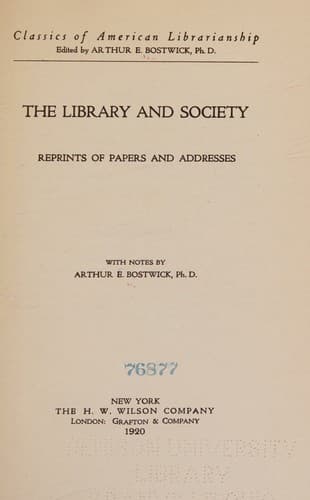
The Library and Society: Reprints of Papers and Addresses
History
The Library and Society: Reprints of Papers and Addresses
Libraries and society; Library science -- Social aspects
Among organizations, women's clubs have probably done the most to assist
library interests. This is especially true in some of the western
states, notably in Wisconsin. Literary and other study clubs which
prevail in New England are certainly in their nature cooperative with
the library, while they might be of more direct assistance to it. The
library, of course, should give these societies all possible
encouragement and help. The clubs will react favorably on the library in
creating a demand for books which will improve the character of the
accessions to the library. Where a study club does not exist, the
librarian should help to form one. It is possible that there is a
tendency to exclusiveness in women's literary clubs. If the number limit
keeps out those desirous of joining, or those who need encouragement in
literary interest, a branch club for their benefit should be formed.
Besides working for their own improvement, the members of study clubs
should have a missionary spirit and should feel a responsibility for the
intellectual welfare of the town. A woman's literary club is capable of
being a strong ally of the public library.
The newly developing local history societies and the public library are
naturally allied, and promise to be of increasing mutual benefit. The
library should buy town histories and books needed by the historical
society, while the latter will contribute to the library records, maps
and published memorials. Further, the historical society, by sustaining
lectures in which the principles of colonial development are illustrated
by local annals, should develop a perception and interest which will be
manifested in a demand for volumes of history now lying dusty on the
library shelves.
The grange is another organization whose objects affiliate it with the
library, since the grange movement is an important culture movement.
There is opportunity for more active cooperation between the library and
the grange. The grange, and also the farmers' clubs, should be asked to
recommend the best works upon agriculture, while the lecturer of the
grange and the committee of the farmers' clubs should confer in advance
with the librarian as to material needed in carrying out their literary
programs. More than one other organization might be mentioned which
would help the library and be helped by it through increased
cooperation, thereby extending the influence of both. It is the sense of
obligation and responsibility that needs to grow.
The public press is an agency which certainly ought to be a firm ally of
the public library, cooperating with it directly and indirectly.
Newspapers should be ever ready to give space to any matter that will
bring the library to the attention of the public, and they should also
keep the public informed of progress in library interests. Deeper than
this, the press should constantly exemplify and teach culture ideals,
the true mission of journalism.
Public-domain text, read in full here on John Shaqi.
Reviews
Reviews
No reviews yet
Be the first to share your thoughts on this work.
Elsewhere in the archive
Join the Discussion
Join the discussion
Sign in to leave a comment or review.
Sign InorCreate an account