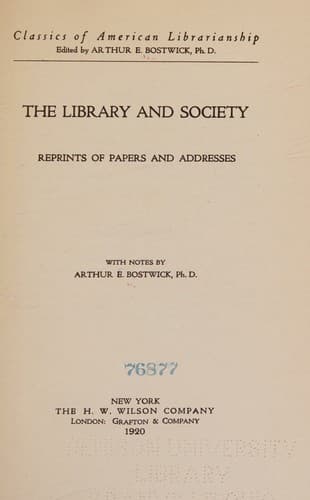
The Library and Society: Reprints of Papers and Addresses
History
The Library and Society: Reprints of Papers and Addresses
Libraries and society; Library science -- Social aspects
Proportioned to the authority of trustees, however, is their
responsibility. To whom much is given, of them much is required. And the
position of the better sort of trustee valuable to the best work of the
librarian, is not that sinecure seat sometimes depicted. He must
constantly stand as the able and ready advisor of the librarian, and for
the honor and defence of the library. He will be made the court of
ultimate appeal in many matters, both practical and curious. He will
receive letters from all sorts of people, some with gifts in their
hands, and some with complaints on their lips; some seeking favors,
possible and impossible. Col. Higginson's humorous way, recently, of
introducing Phillips Brooks as the man whom nobody in the Cambridge
library could find out the height of, until at last the inquiry was
brought to him as trustee to answer, may illustrate the point.
Lately an article in one of the English reviews treats of the "Perils of
Trustees." And while no statute makes us responsible,--as innocent
parties were held to be under British law, in the failure of the Glasgow
Bank,--yet the library trustee carries risks, both moral and financial,
and the place should be offered to none who will not give it a
_bonafide_ service. There is no room for a mere figure-head or
ornamental name on a working library board. Every member of a directory,
rightly organized, should take his share in the administration, and have
some knowledge of what goes on in the library world.
It is true there have been instances where some ambitious and
irrepressible spirit has exceeded his official duties and privileges;
has been disposed to dictate the whole policy of the library, reducing
the librarian's office to that of a mere secretary. I knew a director in
a large library who resigned because he could not buy the books and
write all the reports. He hungered for more to do. But I have known more
than one to keep himself as far away from the board as possible, after
one or two sessions of three or four hours each, in the necessary
deliberations of the book committee.
Edward Everett Hale says that the great essential for the directors or
trustees of any institution is, that they "keep their end in sight," as
Dr. Watt's hymn reads. If it is an institution to help old women, or
save poor children, or find situations for the idle, does it really do
it? Or is it so taken up with the mechanism of the concern, so absorbed
and happy over methods and details, that it loses sight of the object?
This is especially to be considered in the management of a public
library. What is the library for? Is it accomplishing its work? Is it
doing its utmost to promote the virtue, refinement, and intelligence of
the community?
Public-domain text, read in full here on John Shaqi.
Reviews
Reviews
No reviews yet
Be the first to share your thoughts on this work.
Elsewhere in the archive
Join the Discussion
Join the discussion
Sign in to leave a comment or review.
Sign InorCreate an account