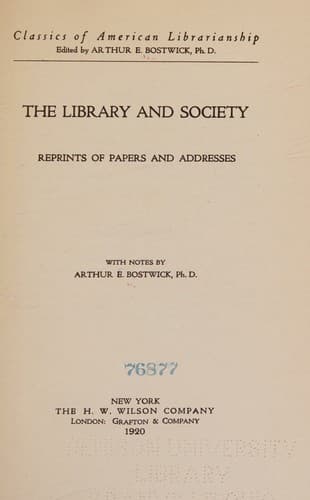
The Library and Society: Reprints of Papers and Addresses
History
The Library and Society: Reprints of Papers and Addresses
Libraries and society; Library science -- Social aspects
The weight of opinion seems to be in favor of small boards; and in
small towns, where the duties are light, three trustees will usually
work more harmoniously and effectively than a larger number. But in
large towns and cities a more numerous board has two advantages--there
is more chance of securing among its members one or two men who are
exceptionally active, intelligent, judicious, and interested in library
science; and the board may be more thoroughly representative of
different sections of the town and different elements in the population.
2. TERM OF OFFICE
The usual and undoubtedly the best composition of a board of library
trustees is to divide it into groups, one group going out of office each
year. This provision secures stability by preventing sudden changes of
the whole board by intrigue or popular caprice, and is intended to allow
opportunity for gradual change whenever it is needed.
But does this provision alone insure sufficient change to prevent
stagnation? The position of trustee of a library is so pleasant and
honorable, that the incumbent may wish to retain it indefinitely. The
men selected as trustees may be personally so worthy and popular that
their townsmen are reluctant to retire them compulsorily, even when the
feeling is prevalent that others might serve more acceptably. To effect
a change under such circumstances requires an effort approaching
revolution, with danger of that discord and bad feeling which are so
unfortunate in library management.
Would it not be wise, in view of this possible danger, to follow the
example of the graduates of Harvard College in electing overseers, and
provide by law that no trustee shall hold office for more than (say)
three successive terms of three years, or nine years in all? While a
library might thus lose occasionally an active and efficient trustee
(who could still be reëlected after being only a year out of office),
would it not gain much more than it could lose, in keeping that close
contact with popular needs and with new ideas, which is so healthy and
stimulating in the management of all public institutions?
3. QUALIFICATIONS FOR THE POSITION
The ideal qualifications for a trustee of a public library (a fair
education and love of books being taken for granted) might be summarized
somewhat thus:--
Sound character; good judgement and common-sense; public spirit;
capacity for work; literary taste; representative fitness.
Men of character and position in the community are usually selected as
trustees; but it may be assumed somewhat too confidently that, because a
man has been prominent in political or business or social circles, he
will make a good trustee. It is a mistake to put in such a position any
man who has outlived his public spirit and energy.
Public-domain text, read in full here on John Shaqi.
Reviews
Reviews
No reviews yet
Be the first to share your thoughts on this work.
Elsewhere in the archive
Join the Discussion
Join the discussion
Sign in to leave a comment or review.
Sign InorCreate an account